Getting paid on a construction project can be cumbersome. Not only do contractors have to deal with some of the longest payment delays of any industry in the world. They also typically have to apply for payment with a packet of documents and receipts that prove they’ve earned it. So when a general contractor or property owner says you have to notarize a payment document, you would be right to be a bit skeptical.
In this article, we look at notarization on common construction payment documents. When is it required (if ever)? How should you respond when a property owner or GC asks (or demands) that you notarize a particular construction document?
What is notarization for, anyway?
Notarization is way of proving the authenticity of a legally executed document . The notary must be physically present to witness the signatures on the document. They’re there to confirm the identity of the person or people signing, typically by checking their driver’s license. A notarized document will have the signatures of the parties to the document, the signature and verification statement of the notary public, and potentially a notary stamp as well.
The job of a notary public is to ensure that the person signing a document is actually who they claim to be. This serves two primary purposes:
Notarization prevents forgery. The notary public checks the ID of the person signing to prevent someone else from faking their signature.
Notarization ensures free, sound decisions. The notary looks for signals that the signer isn’t coerced or intoxicated. That they understand the document has legal consequences, and they’re signing of their own free will.
In the United States, some common legal documents that require notarization are power of attorney, last will & testaments, and real estate transaction documents.
Especially on a large construction project, it’s easy to imagine a scenario where a property owner or general contractor would want the subs to notarize payment documents. If they don’t personally know the subs involved on the project, they may want a notary to confirm the signer’s identity. It’s important that an authorized person is approving the documents, so both parties can avoid disputes later on. However, there are often simpler ways to achieve this same goal that aren’t as tedious (or expensive) for the subcontractor.
So, do you need to notarize that construction document?
Every construction project will require a variety of documents that a contractor needs to provide in order to get paid. It all starts with the contract, which will specify which documents you’ll need to provide throughout the project. So you’re ready to provide them. Now the question becomes: Do you need to use notary services?
Do you need to notarize a construction contract?
Answer: Typically, no.
There are no state laws requiring you to notarize a construction contract, since it’s already binding. Even a verbal contract is legally enforceable in most states. Generally on construction projects, the requirement to notarize a document is actually a contract provision.
Even though it’s not a requirement, there may be advantages to having the contract signed in front of a notary public. If the other party later objects to the agreement, notarization is just extra proof that they originally agreed to the terms. If both parties agree to notarize, it only makes the contract that much stronger.
Do you need to notarize a payment application?
Answer: Typically, no.
A payment application generally doesn’t need to be notarized, unless the contract explicitly calls for it. There’s really no logical need for it, though. Check your contract before you sign it. If the contract requires you to notarize any of the payment documents during the project, see if you can get the GC or property owner to remove that requirement.
This gets confusing when you’re using a payment application like the G702 from the American Institute of Architects (AIA). The pay application includes a section for notarization, but that doesn’t mean it has to be notarized. It’s not a binding document, after all – the owner reviews it with the option to accept or reject it.
As we’ve stated, check your contract. If it doesn’t require you to notarize the pay application, then you can leave that section blank on the pay app.
Do you need to notarize a change order?
Answer: Typically, no.
Construction projects rarely ever go as they were planned, which is why it’s common to see additions and deductions to the scope of work. That’s the premise of change orders. An approved change order contains the description of work, change in cost, and signatures of both parties confirming agreement. If everyone wants to have change orders notarized, then go for it. But there’s really no need. An approved change order effectively becomes part of the original contract, and is enforceable without notarization.
Do you need to notarize a lien waiver?
Answer: Only in 3 states.
Lien waivers must be notarized in 3 states: Texas, Wyoming, and Mississippi.
In all other states, don’t notarize lien waivers. In fact, in some cases, notarizing a lien waiver could actually invalidate it. This is because some states have very specific parameters for the lien waiver form, and the statutes state that waivers should be in substantially the same form. So, adding a notary block does technically change the form, and could potentially be a point of contention when things go south.
Do you need to notarize a preliminary notice?
Answer: Typically, no.
States very rarely require you to notarize a preliminary notice. However, if the state in which your project is located requires preliminary notices to be filed rather than just sent, it is a good idea to check if it also needs to be notarized.
In some states, the notice itself might not need to be notarized, but something else does. Take Arizona, for example. They don’t require notarization on a preliminary notice, but they do require “proof that the notice was given.” This can either be given by the signature of the person receiving the notice, or by a notarized affidavit swearing under oath that it was sent.
In states where claimants aren’t required to send preliminary notice in order to protect your lien rights, you never need to notarize these construction documents.
Do you need to notarize a notice of intent to lien (NOI)?
Answer: Not in most states. But…
In these ten states, you must send a notice of intent to lien (NOI) in order to protect your right to file a mechanics lien:
[Click on any state above to view or download the NOI form. If an affidavit is required with the mechanics lien, it will also be attached.]
*In these states, the NOI requires notarization. **In these states, the NOI itself doesn’t require notarization. However, you must submit an affidavit when you file the mechanics lien. The affidavit is an official document that affirms that you sent or delivered the document. The affidavit needs notarization.
If you live in Delaware or Massachusetts, notarizing a mechanics lien isn’t required, but it’s still best practice to notarize it anyway. In these states, you do need to show another form of “attestation,” or evidence that you filed the lien. What that evidence entails exactly varies by state.
If filing a lien in these states, its best practice to have the mechanics lien notarized anyway. Recorder’s offices can be fickle beasts, and they each have their own internal processes. An office may end up rejecting a non-notarized document, even if the law doesn’t require notarization. In these states, notarizing the mechanics lien can provide extra assurance that the Recorder’s Office won’t hold up its approval.
Bottom line
In some states, you must notarize specific construction payment documents. In others, there is no law requiring notarization – and in some cases, notarizing a document can actually invalidate it. Here’s are some general steps to follow when deciding whether to notarize a document:
Does state law require you to notarize it? If yes, then definitely notarize it.
Does your construction contract require you to notarize it? If yes, then notarize it.
Does your GC or property owner want you to notarize it? If neither the law nor the contract require it, they can’t legally deny you payment if you don’t notarize a document. But you might still want to notarize the construction document just to make them happy.
The ultimate problem with requiring construction documents to be notarized, is the time and cost it requires. Consider the volume of documents that fly back and forth on any given project. Requiring notarization on one or more of these documents is a tedious and burdensome obligation. If working in a state where notarization isn’t required by law, it’s best to leave this issue alone. Exchanging construction documents is stressful enough, why not streamline the process?
However, if you do end up working on a long project where many payment documents must be notarized, it might be worthwhile to have a member of your staff certified as a notary public in the project state.
Getting your mechanics lien filed with the county recorder can be quite the hassle. County recorders have very finicky rules, and their bureaucratic offices can even make arbitrary decisions. In the process of filing your mechanics lien, you may run into frustrating difficulty in actually getting the county recorder to file your claim. This article will help you understand common reasons why county recorders reject or refuse to file mechanic lien claims, and guide you past those rejections to get your document filed…and get you paid!
What It Probably Means If A County Rejects Your Lien Claim
A mechanics lien is a powerful tool that usually works to get you paid (learn how mechanic liens work here). But getting a mechanics lien to start working for you requires that you get the lien filed. As we explored in our How to File A Mechanics Lien guide, getting a lien filed requires great attention to detail. While the details may differ from state-to-state and situation-to-situation. one thing that every lien requires is that it must always be filed and indexed by a county recorder!
This is generally a pretty smooth process.
Generally, the county will record your mechanics lien documents whenever the documents are presented for recording. However, on occasion, a county will refuse and will not accept your document. As you’ll see in this post, this is almost always because the lien document itself does not meet some filing requirements (such as the margin requirements, filing fee requirements, attachment requirements, etc. — more on this below).
This does not mean you are without lien rights. In fact, counties are not allowed to pass judgment about whether you have the right to file the lien. However, without your mechanics lien successfully recorded and indexed with the county, you have not filed it, and you have not asserted your rights yet!
It is extremely important that you figure out what is wrong, and get the lien successfully filed.
The #1 reason liens get rejected: Bad information.
Learn more about job research team. We'll track down and verify all of the job information you need to complete your form and file a valid mechanics lien.
Common Reasons Why Recorder Rejected Your Documents (& How To Fix)
The whole lien process is highly bureaucratic, and small mistakes can derail your success at any step along the way, from sending notices to filing and releasing a lien. When the lien documents are received by the county, they are generally recorded as long as the lien claimant meets all of the requirements necessary for a valid lien (such as margin requirements, any fees, attachments, etc). However, on occasion, a county recorder will not accept a lien document. When the county sends the document back without recording it, they are rejecting the lien document and thus, the lien claim itself. Read on for an overview of some of the reasons why a county recorder office might reject a lien.
1. Insufficient Description of Labor
One common reason we have seen recorders make when rejecting a document is that the claimant’s description of labor is insufficient. We find this rejection reason to be especially challenging since a description of labor that is deemed to be sufficient by one county recorder may be considered insufficient by another county recorder, even when the exact same wording is used. Like a lot of interactions with state bureaucracy, it can seem like the outcome you’re going to get largely depends on whether the clerk you ended up with was having a good day or not!
Here are some descriptions of labor we’ve seen that resulted in the document being rejected for recording:
“Labor and materials for refrigeration remodel and produce case” rejected in Ventura County, California
“Service Work” rejected in New York County, New York
“Project Manager – Hiring, ordering, designing, liaison with client, estimates, approvals, records” rejected in New York County, New York
“Construction Monitoring during construction” rejected in New York County, New York
Best Practices For Writing Your Description of Labor & Materials
It is generally a good rule of thumb to give a broad enough description of what was provided so that it covers all labor and materials provided on the project, but specific enough to give some detail on how the claimant helped improved the property.
For instance, if a claimant provided electrical materials on the project; the description of “provided electrical materials, including but not limited to light fixtures, conduits, and cables” should be general enough to cover all materials provided, and specific enough to provide evidence of what exactly was contributed to the project and property.
While there are statutes in every state to determine who has a lien right, it is not the recorder’s position to reject the recording of a mechanics lien because it does not fit their description of work justifiable to validate a mechanics lien claim.
2. Lack of Supporting Documentation
One common reason that mechanics liens are rejected by county recorders is that the required attachments are not included with the lien when submitted for filing, or are not presented in a format that the recorder deems acceptable.
The types of required attachments can be grouped into three broad categories:
Missing Documentation Showing Proof That Notices Were Sent & Best Practices
Mechanics lien requirements, including notice requirements, vary greatly based on a number of factors. Depending on the circumstances of the project, preliminary notice and/or notice of intent to lien may have been required to be sent in order for the claimant to preserve their lien rights.
Depending on the state where the project is located, a copy of the notice itself, the proof of its mailing, and sometimes both need to be included with the mechanics lien filing as an attachment in order for the lien to be valid.
For instance, in Arizona, theArizona mechanics lien lawsrequire proof that the preliminary notice was sent is required as an attachment on all mechanics lien filings. This is generally a signed acknowledgment from the recipient that they received the notice, or if this is unavailable, an affidavit showing the time, place and manner of mailing and facts showing that such service was made in accordance with the Arizona Lien Statute (33-992.01)
On commercial projects in Arkansas, the Arkansas Mechanics Lien Laws require the lien claimant is required to include a copy of the notice of intent to lien that was sent on the project, as well as a copy of the 75-Day Notice to Owner.
Make sure you check the requirements for your state before submitting your lien to the county.
Missing Documentation to Prove Labor or Materials Delivered & Best Practices
Certain states require that the lien claimant provide evidence that there was work commissioned and completed, and that there is still a balance owed on the project. The two most common documents to prove this are invoices showing outstanding amounts and a copy of the written contract, but you may also include documents such as receipts and email communications regarding the project.
New Mexico’s lien laws, for instance, requires that you include a copy of the written contract, or a description of the agreed-upon term if the agreement was verbal. Arkansas requires that invoices, an itemized statement, or other documentation showing the amount due and work done be included.
A few of the other states that require proof of work performed include Pennsylvania, Arizona, and Wyoming. Make sure you check the requirements for your state before submitting your lien to the county.
Missing Documentation to Prove Licensing and Authority Requirements & Best Practices
Depending on the work performed and the state in which it was performed in, a lien claimant may need to provide proof that they were licensed to perform such work in order to have a valid lien claim.
“provide the county clerk of court or register of deeds proof that he is licensed or registered if he is required by law to be licensed or registered. As proof of licensure or registration, the contractor must record his contractor license number or registration number on the lien document when the lien document is filed.”
In Washington D.C., not only is the lien claimant’s business license required, but also their Certificate of Good Standing issued by the Department of Consumer and Regulatory Affairs.
If you seek help from an external party such as a lawyer or service like Levelset, you may need to include a document granting them authority to act as your agent. While most states allow for outside parties to act as agents and file documents on their behalf, some states require explicit consent in order to file the lien. New York and Washington DC, for example, require an “Authority to Sign” document to be included with the mechanic’s lien.
What If I Don’t Have the Required Documents?
If the documents are required and not provided, the lien will likely be rejected. Washington DC and New York are notoriously strict on rejecting documents that do not have attachments included.
If the lien is submitted without required documents but still gets recorded, it may be deemed invalid during the legislation proceedings if the claimant is forced to file a lawsuit in order to enforce the lien claim.
Another frustrating thing that can happen is when your attachments don’t comply with the county’s formatting requirements. Arizona, for example, requires a number of attachments, including a copy of the written contract. However, we’ve seen Arizona’s Maricopa County reject lien filings because the contract was drawn up on a gray-colored piece of paper instead of the specified white. This county has also rejected a lien filing because an invoice was printed in landscape format rather than portrait format!
If Attachments Aren’t Required, Can They Still Be Included?
Generally, yes, attachments may be included.
The most common documentation that is included with lien filings are contracts and invoices. In some states including Kansas, Texas, and Louisiana, it is both encouraged and best practice to include extra documentation proving the work was performed.
Even though this extra documentation is not statutorily required, we have seen instances where recorders in these states rejected a lien filing because attachments that weren’t even required in the first place were not included! So, if you’re in one of these three states, the best practice is to include any supporting documentation you have, even if it’s not required!
But, don’t go crazy — counties charge per page, and so if you include a bunch of attachments, you may wind up paying big bucks!
3. Filing a Lien Without Lien Rights
Another common reason for a mechanics lien rejection is that the lien claimant is attempting to file a lien for labor that they don’t actually have lien rights for. This might sound silly, but determining whether or not a company actually has lien rights on a project is not as straightforward as it may sound, and we’ve seen too many instances to count where a construction company thought they had lien rights on a project only to find out later that they did not. Sometimes, these parties never had lien rights to begin with – an example of this is that in many states, suppliers to suppliers do not have lien rights. Other times, a party may have had lien rights on a project to start with, but lost those rights due to an unmet requirement (such as failing to send a preliminary notice) or a missed deadline.
The lien claimant’s role on the project and the labor/materials provided will affect the ability to file a valid mechanics lien depending on the state the project is located. For instance, in New York, mechanics lien protection is fairly broad and extends to every:
“contractor, subcontractor, laborer, materialman, landscape gardener, nurseryman or person or corporation selling fruit or ornamental trees, roses, shrubbery, vines and small fruits, who performs labor or furnishes materials for the improvement of real property.”
Except for suppliers, a lien claimant’s tier on a project is inconsequential. There are some exceptions, however. A lien claimant must be licensed to do the work (if a license is required), and must be authorized to do business in New York. The lack of a license or authorization to do business when required is fatal to the lien claim. A supplier to a supplier is not allowed to file a mechanics lien in New York.
Contrast the practice in New York to the way it’s done in Utah, where these parties are explicitly covered by the Utah Mechanics Lien Laws:
“In Utah, contractors, subcontractors, and other furnishers of labor and/or materials to the project (including equipment lessors) have mechanics lien rights. Lien rights also extend to some pre-construction services, such as planning, designing, and surveying. Unlike some states, suppliers to suppliers are entitled to mechanics lien protection in Utah as long as the materials supplied can be traced to the actual project – and the party complies with the notice requirements.”
Best Practices For Figuring Out If You Have Lien Rights
For starters, there is a wealth of extremely useful information and resources available for anyone in the construction industry to use, available for free on the Levelset website. If you’re confused about whether your company has lien rights on a particular project, it’s a good idea to start there.
4. Other Technical Reasons
Some of the most common reasons that liens get rejected are administrative in nature – so-called “technicalities.” Here’s an incomplete list of some other mistakes or issues that can lead a country recorder to reject your lien:
Page margins
Font size and type
Placement of specific text on the page
Incorrect legal description
Minor typo
Insufficient recording fees (of even less than $1)
Incorrect payment type (business checks, attorney checks, money orders)
Special requirements for the first page of the document are missing
Sending the document to the wrong county!
Missing a cover page that is required
Omitting statutorily required language in the claim
Best Practices For Avoiding Technical Problems & Mistakes With Your Lien Claim
If some of these reasons seem a little minor (Incorrect margins? Really??), all we can say is, close only counts in horseshoes and hand grenades, and filing a mechanics lien is neither. Before heading off to the recorder’s office to file your mechanics lien claim, you’ll want to research the county’s recording requirements in-depth. And you’ll need to comply with these requirements very closely! So pay close attention.
Another best practice is to just use a lien filing service like Levelset, for example, who can make these little county annoyances go away.
5. The County Makes A Judgment Call
Lastly, liens can be rejected by the county when the recorder makes a judgment that the lien document should not be filed, or should include something that is not legally required. In our opinion, county recorders should NOT do this. We go through this in great detail in the below section of this post.
Examples of these “judgment calls” can include:
Determining the property description is not descriptive enough
Determining that the labor/materials provided by the potential claimant do not warrant a mechanics lien claim
Determining that the notary information is not clear enough, or presented in the correct format
Your Lien Was Rejected…Now What?
If your lien was rejected, not all hope is necessarily lost. Information can be updated (legal property description, cover pages, etc.) and the document can be re-prepared and submitted for recordation if you are still within the deadline to file the lien claim.
It is always best to leave ample time before the lien deadline cutoff to account for the recordation process (and the possibility that your lien may be rejected on your first attempt), as it may take the county some time to return a rejected document. While some states are much quicker and easier to record a lien in, Levelset recommends ordering your lien with at least 14 days before your deadline to allow for the lien recordation process.
County clerks and recorders should be completely agnostic as to what is and is not qualified for recording. Unfortunately, it’s sometimes hard for legislatures and recorders to draw (or see) the line. This post is about why recorders should not be authorized to reject any filings, and whether they inappropriately do so currently.
Why Clerks and Recorders Should Not Decide On What Mechanic Liens Are And Are Not Recordable
At first glance, you may not see the problem in requiring proof of license to record a mechanics lien. After all, if a license is required, shouldn’t the contractor need to prove it?
Ah, but that sentence contains the hiccup, and so does Vincent’s blog post on the subject: when exactly is a license required? Here is Vincent’s terrific explanation:
What if there is a difference of opinion between the contractor and the clerk that is issuing this certification as to whether a license is required? If the clerk refuses to accept the mechanic’s lien for filing, and it is ultimately determined that the lien should have been accepted, the right to file the lien may have expired in the interim. There are a number of nuances in the licensing statutes for each county and those nuances have not yet been completely ironed out by the court systems despite extensive litigation. How is a county employee supposed to make such a determination when the statutes themselves are not clear, especially because determining applicability requires a fact specific analysis? While the problem of unlicensed contractors filings mechanic’s liens is indeed a problem, it is one that the courts can address – they can vacate the mechanic’s lien and if necessary award the home owner damages. The legislature should not put the life or death of a mechanic’s lien in the hands of a county employee that likely would not have the knowledge (either legally or factually) to determine if a license is required for that particular work.
Whether a contractor is licensed or not is just one issue – the county clerks sometimes stick their noses (authorized or not, see below) in a whole host of other legal issues, such as:
Is the description of the property legally sufficient?
Is the mechanic’s lien filed on time?
Does the claimant have an underlying lien right?
Does the language within the mechanic’s lien meet statutory requirements?
The list goes on and on and on. All of these things are legal determinations that may or may not impact the effectiveness of the mechanic’s lien filing. Can a county employee make these determinations? Should they?
They neither can nor should. But, as I’m about to show you, they constantly and inappropriately do.
Mechanics Lien Claims Are Constantly Rejected By Recorders For Unauthorized Reasons
The unfortunate truth is that county clerks and recorders constantly overstep their authority, and there is very little a claimant can do about it. The clerks are usually immune from suit, and even if they later relent and let you file, their new cooperation may be too late to save your mechanics lien rights. It is precisely why we recommend giving yourself as much time as possible to file a lien, becausethings out of your control can go wrong when trying to file.
I’ll give you three real-life examples of recorders overstepping their authority in making a decision about what is and what is not lienable. Remember, universally, courts are prohibited from making legal determinations about the validity of a filing. It is their job to stamp documents. That’s it.
Example 1: Possible Arbitrary and Capricious Conduct By The St Tammany Parish, Louisiana, Clerk of Court
Example 2: California Clerks Are Confused About Requirements Of California Mechanics Lien Extension
Filing a mechanics lien extension in California is quite rare because it requires the property owner’s signature. As a result, the recorders don’t have much experience with the document. They also do not understand the document’s requirements.
Example 3: New York County Recorder Refused To File Mechanics Lien Because Work “Not Lienable”
The final example comes in New York where a company’s lien was rejected by a clerk in New York, based on the work not being “lienable.” The filing company’s work was for “testing on a building undergoing renovation.” The clerk rejected the lien stating that “testing” was not included under the lien laws of New York.
Again, here is the clerk making a legal determination which is outside their scope of authority. They may be right…or they may be wrong. But, it’s really not their place to say, especially in this case where the description of work provides only a glimpse at what was done at the property.
County Recorders – Their 5 Worst Habits
We love county clerks and recorders. They are an integral part of the execution of mechanics lien laws in all 50 states, nationwide. They control, process, and file hundreds if not thousands of mechanics liens each and every week, all in service of helping a company just like yours get paid the money that they’ve rightfully earned on a construction project.
Sometimes though, they really push our buttons.
From our experience filing many thousands of official construction documents nationwide, here are the five worst habits of county recorders (and why you should be on the lookout!).
Having Completely Unrealistic Recording Standards
While all recording offices will have quality standards for documents, some have more unrealistic expectations than others. For example, in Arizona, most recorders use a process of scanning and storing documents via micrographic film. This process is infamous for distorting documents if the text is not spaced out. While this may seem reasonable to include proper spacing in all documents submitted to the recorder, Arizona generally requires exhibits (such as the written contract or invoices) to be provided as an exhibit with the lien. Often times contracts can have handwritten components (such as signatures) or may have images such as diagrams, logos, or pictures included. Microfilm will significantly distort these visual elements, making the document illegible and leading to its rejection for recording. Rejecting a document due to to the process of using microfilm is a completely unrealistic standard to hold over lien claimants, and yet it still persists. We’re looking at you, Arizona!
Astronomical Fees
In New York, several counties have raised their recording fees for mechanics liens in recent years to as much as $300 (and in some cases even more). This is the cost just to file with the county recorder and does not include any of the other costs commonly associated with a lien filing including mailing and postage costs, attorney or lien software processing prices, or notary fees. In particular, Nassau County is notorious as one of the most expensive counties to file a lien within the entire country! While the costs to file a mechanics lien may vary around the country, very few counties come as close to this steep in price and with little to no explanation as to why the prices are so expensive. We all know the cost of living in New York is among the highest in the country, but this is ridiculous.
Poor Phone and Web Support
In our experience, many if not most counties have excellent phone support, exceptionally clear directions easily found on their websites, and in some cases, even both. Unfortunately, it’s not uncommon to find the opposite – counties that provide neither helpful phone support nor useful web assistance. In this category, we would include counties that don’t provide any document updates over the phone (even better would be online, but baby steps!), and others that rely solely on USPS to send your documents back. Sometimes the directions are there and easily found, but they’re so poorly worded that reading them is of little or no help. Still, other counties provide “directions” that leave out essential recording requirements, such as current fee schedule. Since most counties will reject a document sent with improper fees, it would make sense for the recording offices to make sure this information is accurate and readily available!
Having Slow-as-Molasses Return Policies
Most counties will record documents the same day, or within a few days, of receiving them. However, other counties do this really annoying thing where they record the document quickly and then…they let the recorded document sit in their offices for weeks at a time. These same counties often mail outgoing documents just once a week or so in batches. This causes a painfully slow return of the recorded documents that can keep a claimant biting their nails until they get the document back weeks later. Georgia, for instance, has some of the nicest recorders in the country, and a wonderful online search tool for finding recorded documents. But their processing times on sending recorded liens back in the mail is over three weeks long on average. Way to keep us all on the edge of our seats, Georgia!
Not Providing ALL of the Reasons for a Document Rejection in the Initial Rejection Letter
Are you familiar with the Greek myth of Sisyphus? Sisyphus was punished by the gods to spend eternity rolling an enormous boulder up a steep and winding hill, only for it to roll back down the moment he got to the top. Please keep this in mind when reading about what is, in my opinion, the most annoying of all recorder habits by far.
Every day and in every state in the country, documents get rejected by county recorder offices. It’s a natural but frustrating part of the process – it’s just the way it is. But the reason why a recorder decides to reject a document is a crucial piece of information since claimants rely on the rejection reason so that when they re-submit the document, they can do so with the assurance that they’ve gotten it correct.
And so, in cases where a recorder rejects a document for multiple reasons, but they don’t include all of those reasons in the rejection letter, they set the claimant up to get rejected again, this time for a mistake that was there the first time but wasn’t brought to the claimant’s attention. Sometimes a resubmitted lien will be seen by a different recorder, and when seen by a fresh pair of eyes it may be rejected again for new reasons. Other times, recorders may not want to fully inspect a document for other inaccuracies once they find the first mistake. When this happens (and believe us, it happens!), a lien claimant may be forced to record their document multiple times over many weeks, finding out each mistake one-at-a-time instead of all at once. So annoying, and I’m sure anyone reading this will surely agree!
Summary Of Why County Recorders Reject Lien Filings
Counties can be frustrating to deal with, but it’s critical to get your document through their bureaucracy and filed! One best practice to help with this is to use Levelset to file your mechanics lien.
Levelset’s documents are compliant with every state’s lien statutes, and we’ve done all the research for every town/parish/county clerk’s filing procedures (although we even still cannot predict every single time a county will reject a document. Sometimes clerks record anything that comes before them, and other times, well, they can be picky!). Nevertheless, the best way to get your lien recorded, and the easiest way to deal with all county recording issues, is to file your lien with Levelset.
Finally! That big payment problem has come to an end. Whether you’re the person who filed a mechanics lien, the general contractor, a property owner, or someone else – battling out a payment dispute can be brutal. But even when both sides have come to an agreement, there’s one more detail to sort out — filing the lien release.
But when should you file the lien release?
Specifically, what comes first: The payment or the release? Do you swap them at the exact same time? Exchanging payment for the release can turn into a standoff, so what should you do then?
A payment bond is a type of surety bond purchased by a contractor to protect the property owner by guaranteeing payment to all the subcontractors and suppliers below them on the project.
There are so many different types of construction bonds used in the industry, it can feel overwhelming. The good news is that just two types of bonds that make up the majority of those used in the construction industry: payment bonds and performance bonds. General contractors are typically required to secure both performance and payment bonds on most federal and state projects, and they are sometimes used on private construction jobs as well.
But how do payment bonds work, and who do these bonds protect? Let’s dig in.
How do payment bonds work?
Payment bonds ensure that subcontractors and suppliers receive payment for the work they complete.
On a private construction project, if a subcontractor or supplier doesn’t receive payment, they can file a mechanics lien on the property. But when a payment bond is present, that bond effectively takes the place of the property for the purpose of making a non-payment claim. Instead, anyone who isn’t paid will need to file a claim with the surety, rather than securing their interest with the property itself.
This is why payment bonds are typically required on public projects, whether state or federal. The government doesn’t allow liens to be placed upon their own land. So to ensure that everyone on the job gets paid, they require the general contractor to purchase a payment bond.
You can think of a construction payment bond as an insurance policy in case the contractor cannot or will not pay the other parties on a construction project. The bond represents a “pile of money” that parties may make claims for payment against for payment of money they’ve earned on the project.
On public construction jobs (both at the federal and state level), the prime contractor (the one contracting directly with the public entity) is typically required to get a payment bond from an accredited surety company, and the bond itself must be a specific value.
Payment bonds vs performance bonds: What’s the difference?
The difference between performance bonds and payment bonds is actually simple: A payment bond protects the property from lien claims by ensuring that subcontractors and suppliers get paid, while a performance bond guarantees that the contractor will complete the contract.
Payment bond requirements for all 50 states
Generally speaking, the required bond is set by the value of the project’s total contract value. However, in some cases, and for exceptionally large projects, it is not feasible to require the general contractor to obtain and post a many-multi-million-dollar bond. In these cases, there may be tiers of acceptable bond amounts as a percentage of the total contract, which decreases as the project value goes up.
For example, a construction payment bond may need to cover the entire construction contract amount for a $5 million project, but a $50 million project only requires a bond of 50% of the total contract value. The required bond amounts are set out in the specific statutes of the state in which the project takes place.
State
Contract Amount
Required Bond
Alabama
$50,000
50%
Alaska
$100,000
Depends
Arizona
$100,000
100%
Arkansas
$20,000; charitable orgs $1,000
100%
California
$25,000
100%
Colorado
State: $100,000; City/County/Other: $50,000
Depends
Connecticut
$100,000
100%
Delaware
All
100%
Florida
$100,000, but projects less than $200,000 may be exempted from bond requirement by any gov’t agency; Orlando-Orange County Expressway Authority may waive bond reqs on projects less than $500,000.
100%
Georgia
$250,000; $50,000 for DOT projects
100%
Hawaii
$25,000
100%
Idaho
None given
85%
Illinois
State: $50,000; political subdivision: $5,000
100%
Indiana
$200,000
100%
Iowa
$25,000
Depends
Kansas
$100,000; $1,000 for state highway projects
100%
Kentucky
$25,000
100%
Louisiana
$150,000
50% (in most cases)
Maine
$125,000
100%
Maryland
$100,000; None given on state highways
50%
Massachusetts
Commonwealth: $5,000; All others: $2,000
50%
Michigan
$50,000
Set by state, but no less than 25%
Minnesota
$75,000
100%
Mississippi
$25,000 but security may be required on contracts under that amount
100%
Missouri
$25,000
100%
Montana
$50,000; school district projects: $7,500
100% – state; No less than 25% – municipal
Nebraska
State: $15,000; other: $10,000
100%
Nevada
$100,000
50%
New Hampshire
$35,000
100%
New Jersey
State Division of Building and Construction: $200,000; other state departments: $100,000
100%
New Mexico
$25,000
50-100% at state’s discretion
New York
None given
None given
North Carolina
$300,000
100%
North Dakota
All public work requires bond
200%
Ohio
All public work requires bond
Not specified
Oklahoma
$25,000
100%
Oregon
$100,000; highway: $50,000
100%
Pennsylvania
$5,000
100%
Rhode Island
Roads: $50,000; all others: None given
50-100% at state’s discretion
South Carolina
$100,000; DOT projects: $10,000
Hwy – 50%, all other – 100%
South Dakota
State projects through Bureau of Admin: $50,000; others: $25,000
100%
Tennessee
$100,000 except highway are set by DOT
25%; Hwy set by DOT
Texas
Municipality or joint board created under Transportation Code: $50,000; all others: $25,000
100%
Utah
All public work requires bond
100%
Vermont
Not specified
100%
Virginia
$500,000; $250,000 for Commonwealth- funded highway projects which may be increased to $350,000 in some cases
100%
Washington
Up to $35,000 – 50% retainage may be substituted in place of bond; between $35,000-$100,000: individual sureties may be substituted for bond; otherwise: $100,000
100%
Washington DC
$100,000
50%
West Virginia
All public work requires a bond
100%
Wisconsin
State: $100,000; local: $50,000
100%
Wyoming
$7,500
50% for contracts under $100,000
How filing a bond claim helps contractors get paid
When a project participant such as a subcontractor or material supplier has a payment issue on a project, filing a bond claim can be a very effective way to secure payment. Payment bonds give construction parties an option to get paid without the ultimate step of a foreclosure sale of the property. While litigation may still ensue, recovering from a pile of cash has no real difference than recovering through the property itself, and practically, it may be easier.
Make a bond claim now
Levelset takes all of the guesswork out of the claim process. We’ll verify your rights, research the project information, and ensure your claim is done right.
Further, a bond claim brings another party into the mix to help resolve issues: surety bond companies. These surety companies will apply extra pressure on the contractors to resolve issues. And since sureties will not continue to provide bonds to contractors with claims filed against them constantly, GCs pay special attention to bond claims that are filed against bonds they provide.
Payment bonds on private construction projects
The procedure for a private payment bond depends on the state you are in. Some states disallow mechanics liens to be filed if there is a bond posted on the project already. For example, in Florida, the state lien law prohibits unpaid contractors and suppliers from filing a mechanic’s lien if there is a bond posted. Instead, the unpaid parties must file the claim against the bond. Other states do not have specific laws on this procedure. Practically speaking, small private projects rarely have payment bonds, and these are reserved for large-scale commercial projects.
Bonding off a mechanics lien
In some cases, a private bond may be used as a reactionary tool to “bond off” or “bond around” a lien against a property. In other words, a bond is posted after the mechanics lien is filed to release the property but still make sure the lien claimant is provided security.
Payment bond claims yield results
Payment bond claims can be just as beneficial as mechanics liens and, in certain respects, can be even more effective. Payment bonds give construction parties an option to get paid without the ultimate step of a foreclosure sale of the property. While litigation may still ensue, recovering from a pile of cash has no real difference than recovering through the property itself, and practically, it may be easier.
Further, a bond claim brings another party into the mix to help resolve issues: surety companies. These surety companies will apply extra pressure on the contractors to resolve issues. And since sureties will not continue to provide bonds to contractors with claims filed against them constantly, GCs pay special attention to bond claims that are filed against bonds they provide.
At Levelset, we file hundreds of mechanics lien documents a month, all across the United States. The documents are sent to the county (or town) recorder offices, where they are to be filed and indexed on public record.
Documents have certain requirements that are necessary for recording, such as margin requirements and the fees to record said document. Outside of that, the county recorder generally should NOT reject a document for recording based on their interpretation of the information on the document.
Does your state require mechanics liens to be notarized? The answer is: it depends on the state. Read on for a comprehensive, state-by-state guide covering notarization requirements for mechanics lien filings.
What is a notary?
First, let’s answer the question: What is a notary, exactly?
Contrary to what you may have heard, attorneys are NOT automatically notary publics. But a great many are. And when it comes to filing a mechanics lien, you just might need a notary public to sign off on your claim in order to make it valid.
Think of a notary as someone that has the legal authority to answer the age-old, “says who?” question with, “says me.” Notaries public are like professional character witnesses, and their stamp is a legally recognized seal-of-approval that basically verifies that the content of your document is valid, true and correct. This is otherwise known as an attestation.
Get free mechanics lien form
We're the mechanics lien experts. We offer forms made by attorneys and trusted by thousands.
States that do not require a notary for mechanics liens
The following states have no notarization (or any other attestation) requirements for mechanics liens:
* A lien release must be notarized in California, however. ** Although not explicitly required by statute, it’s considered best practice to notarize liens in Georgia to avoid complications.
States that do not require notary, but do require attestation
These states just couldn’t leave well enough alone. While they don’t require lien filings to be notarized, they do require a lien filer to jump through various other hoops that, if not done properly, might cause your filing to be rejected or invalidated:
States that require you to notarize mechanics liens
If you live in one of these states and are having some difficulty getting paid on one or more construction projects, then it might be time for you to get the name of a good notary:
States that require notarization AND additional steps
These states are doing their best to make filing a lien as difficult as possible. Not only do they require all lien claims to be notarized, each has their own set of special steps required to insure the validity of your claim:
The following question pops up frequently on construction projects: “Can I file a lien even though I don’t have a written contract?” And, as with most of the questions we get about mechanics lien rights, the answer is: it depends.
Handshakes and verbal agreements are common in the construction industry, but finding answers on how lien rights apply to contracts that are not written and signed can be a challenge. We’ve collected the relevant information from all 50 states’ mechanic’s lien statutes and compiled it here to make this question easier to answer.
First things first: Who can file a mechanics lien?
This question comes from property owners and construction professionals alike. Owners want to know if a contractor, subcontractor, or supplier has the right to file a lien — especially when someone they’ve never heard of filed a lien on their property! Construction pros want to know their recourse options if they’re having trouble collecting payment.
The basic rule is that anyone who provides labor or materials to a permanent improvement on real property has the right to file a lien. Of course, rules are made to be broken — and this rule doesn’t apply in all situations.
But in general, if you’re a property owner: Anyone who works on your construction project or supplies building materials or equipment can file a lien if they don’t get paid. It doesn’t matter if they have a contract with you, or if they have ever met you. Maybe the general contractor hired them, or maybe a subcontractor did. They don’t need to have a contract with you — they just need a valid contract with someone on the project.
But that begs the question: What constitutes a valid contract for the purpose of filing a mechanics lien?
State rules for contracts & mechanics liens
Mechanics lien rules vary widely from one state to the next, so it’s necessary to understand your state’s lien laws in order to secure your lien rights. When it comes to whether construction contracts must be in writing or not to qualify for lien rights, some states strictly require a signed contract, while others are more flexible.
States typically fall into one of the following 4 categories when it comes to improvement contracts and lien rights:
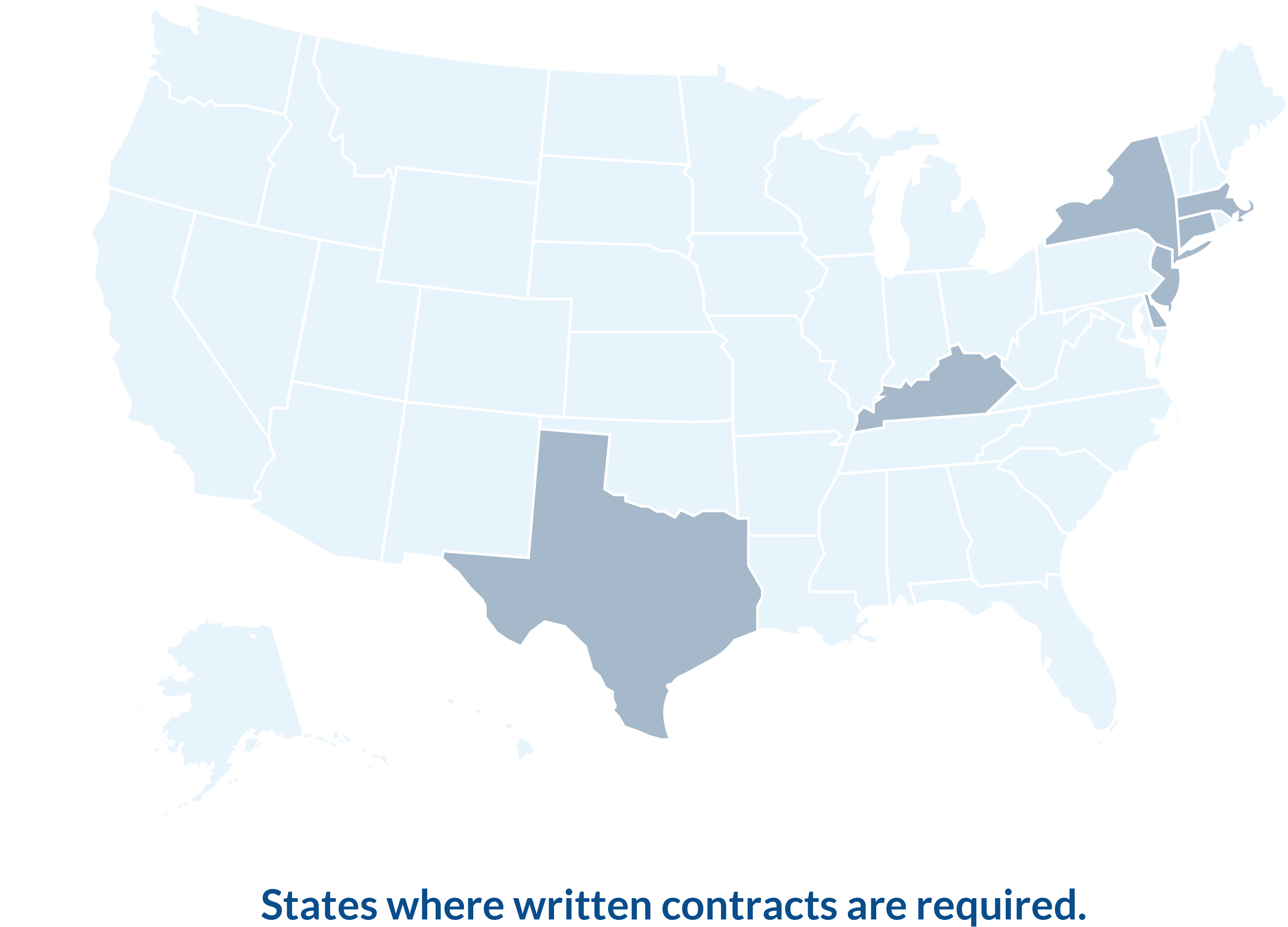
States where written contracts are explicitly required to secure lien rights
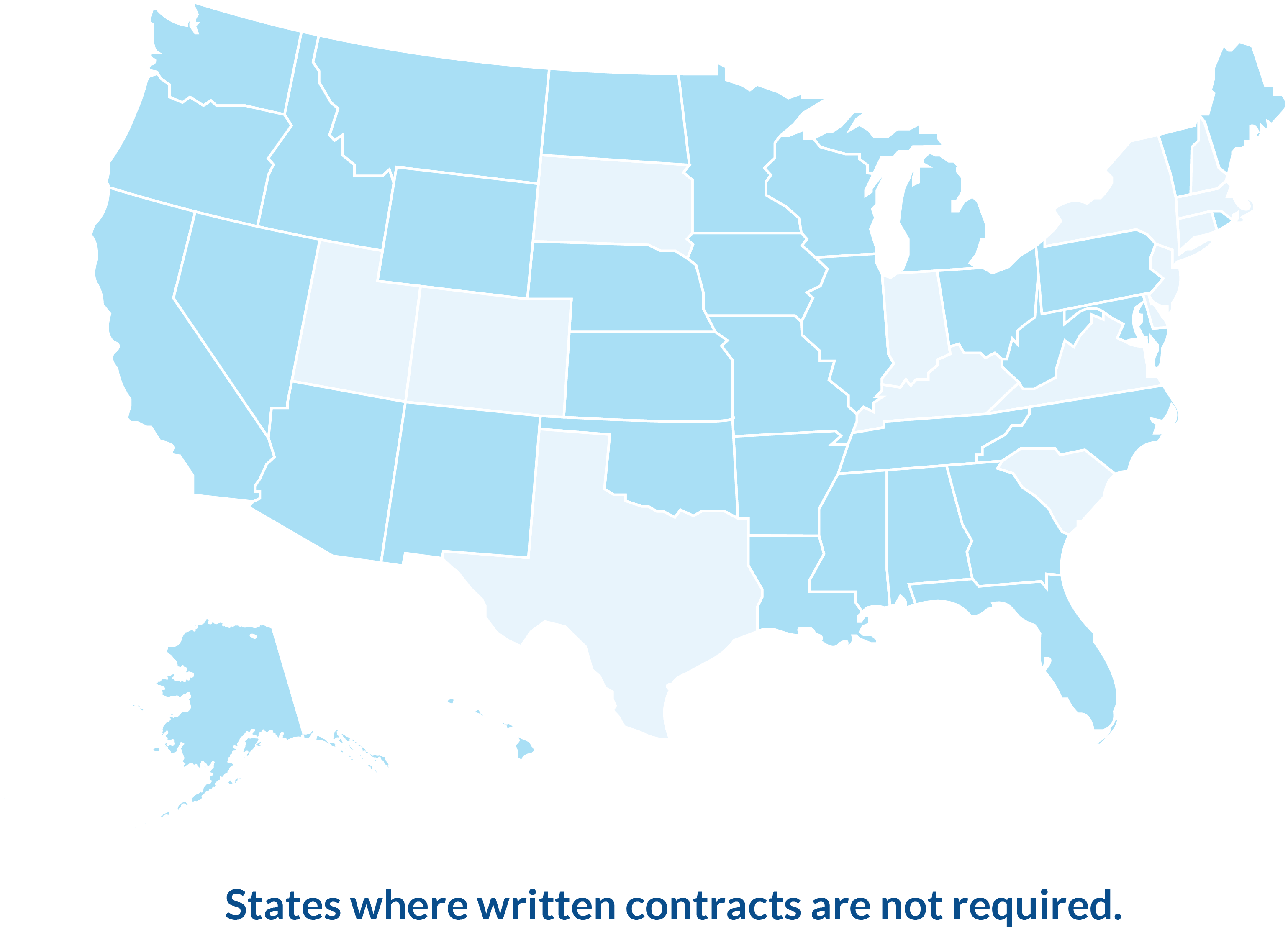
States where written contracts are not required to secure lien rights
States with rules on contracts based on the amount or type of work
States that don’t specify types of acceptable contracts
The maps and discussion below provide a general guide as to whether a contract type affects mechanics lien rights for contractors, suppliers, and other construction parties.
Most states don’t require a written contract for lien rights
In most states (37 of them), contractors and suppliers are generally allowed to file a lien even if they don’t have a written contract. In other words, the contractor could be working off on a verbal agreement, and yet still have the ability to file a lien claim.
Even though these states may permit a construction business to claim a mechanics lien even without a written contract, it is best practice to have a signed written contract for work provided. Documentation is crucial in the construction industry, and many times, what a party has documented is more important than what actually happened!
These statutes typically use language like “for the specific contract or agreed upon change” (New Mexico) and “contract means an agreement that provides for all or part of a work or improvement” (California) to describe contracts, and do not explicitly require that contracts must be written.
However, as explored with a situation in Ohio, not having a written contract can really clutter issues and create a sticky mechanics lien dispute.
These states typically permit parties with verbal, oral, or even implied contracts to claim lien rights. Be sure you familiarize yourself with the specific rules in the state you’re working in. Click on your state in the list to view each mechanics lien statute in full.
6 states prohibit mechanics liens without a written contract
In these states, a written contract between the party providing work and the hiring party is an absolute necessity in order to secure lien rights. Contractors, suppliers, and other parties can only claim a mechanics lien for funds mentioned in written contracts. If it’s not in writing…then you don’t have lien rights! Simple as that. Here are the states that require a written contract to file a lien:
**In Texas, the prime contractor must have a written contract with the owner(s) in order for anyone on the project (contractors, subs, suppliers, etc.) to file a mechanics lien against residential homestead projects. Further, architects, engineers, surveyors, and landscapers need to have written contracts for all projects.
Note: For Texas projects that start on or after 1/1/22, design professionals will no longer need to have a written contract with the property owner to have lien rights.
The information on this page has already been updated to reflect the new rules.
States require a contract for certain amounts or type of work
There are three states — Arizona, Colorado, and Indiana — that require written contracts sometimes, depending on the value of the work being performed, or the type of work being performed. Contract requirements in these states have more to do with the type of work being provided or the type of project, rather than with the actual form of the contract itself.
Arizona: For owner-occupied residential projects, only claimants who have a written direct contract with the owner will be entitled to file a mechanics lien. Further, on all projects, design professionals will only have mechanics lien rights if they have a written contract with the owner or have a contract (verbal or written) with someone else who has a written contract with the owner.
Colorado: Colorado’s lien statute is relatively straightforward, and the written contract requirement is based on the contract price. The relevant part of the statute states that if the amount to be paid exceeds $500, the contract must be in writing in order to claim a mechanics lien. Any agreement for work or materials below this amount is not required to be in writing to file a valid mechanics lien claim.
Indiana: Indiana’s approach to this issue is a bit different, as they rely on who the property owner is. If the property is owned by a public utility, municipality, joint agency, rural electric membership corporation, rural telephone cooperative corporation, or not-for-profit utility, a written contract is necessary to secure lien rights. Also, a copy of the contract has to be filed and recorded in the recorder’s office within five days of the execution of the contract.
Oregon: If the project involves a residential structure, or a zero-lot-line dwelling, and the contract price is $2,000 or more, the original contractor must have a written contract with the property owner. If the price of the contract was initially less than $2K, but during the course of the improvement, the contract price exceeds $2K, the contractor must deliver a written contract within 5 days after the contractor knew or should have reasonably known, that the contract price will exceed $2,000. Failure to have a written contract on such projects, will preclude an original contractor from filing a lien claim.
5 states don’t have clear laws
Some state laws don’t make this question easy because they aren’t specific about whether or not contracts must be written in order for a contractor or supplier to file a lien. Oral contracts are typically valid so long as they adhere to the state’s rules on contracts, but companies should consult with a lawyer if they questions about a specific situation and don’t have a clearly defined written contract.
This question is interesting because it presents a twist to the “written contract” discussion. The question here is really about “privity of contract,” and not whether the contract is written or verbal. This question appears to come from a homeowner who didn’t contract with a subcontractor at all. As such, the subcontractor doesn’t have a “written contract” with the owner. In fact, the subcontractor doesn’t have any contract with the owner — neither written nor verbal!
However, presuming the subcontractor has a contract with the general contractor (or someone!) on the job, the subcontractor will have lien rights in this case. And since this project is in Arizona, and we know Arizona doesn’t require contracts be in writing, this sub would have lien rights even if the contract was just an oral agreement.
A very similar question was asked about a Texas situation…and as we saw above, Texas does require contracts be in writing. However, presuming that the subcontractor on the project has a written contract with someone, they can still file a lien even if they don’t have a written agreement with the property owner.
What exactly is a contract? Is a purchase order a contract?
Another important question that needs to be answered is what constitutes a “contract?” You have some stuff in writing, but is it actually a “contract?” Where is the line drawn?
This is a common question and one that came up on our Expert Center when a material supplier asked, Do purchase orders count as a contract? To answer this question, the construction attorney went into the legal requirements to form a contract. These can be really sticky requirements, and it’s not always clear. Ultimately, the answer concluded, a purchase ordermay ultimately create a contractual relationship between the parties if all the required elements are present.
Another common question that arises in this “written contract” category is about changes to the work. It’s super common that changes to the contract and to the work occur throughout the course of a construction job. And with the speed of construction, these changes frequently don’t get neatly documented. Extra work will get approved orally, or a change may be demanded without even agreement! What happens then? Do change orders need to be writing for lien rights, too?
The answer provided, and the general answer to provide is that if the written contract requirement is satisfied and there is a written contract in place, changes and authorized work may still be subject to a lien, even though a second contract wasn’t executed. The changes themselves, in other words, are actually done under and within the original contract.
Get free mechanics lien form
We're the mechanics lien experts. We offer forms made by attorneys and trusted by thousands.
Don’t chance it: Get the contract in writing
It’s always a good idea to get a written contract to ensure a smooth payment process and to minimize risk. Regardless, in several states, oral agreements (or even implied ones) are more than sufficient to secure lien rights. This article is meant to give a general overview of the requirements as a jumping-off point for those curious about whether or not it is necessary to have a written contract in order to secure mechanics lien rights.
Thousands of lien waiver forms are exchanged every month across the country. Whether you need to exchange a lien waiver for a progress payment or final payment, choosing the right template is important. Some states have statutes that require specific language on the form – using the wrong form could invalidate the waiver. Other states don’t regulate lien waiver forms – as a result, the language on the form could be misleading or dangerous. In all cases, we’ve made finding the right form easy.
A lien waiver may be called a waiver of lien, a lien release, a lien waiver and release, or some combination. Regardless of what the document is called, it’s the language in the document that really matters. Signing a document without understanding what the language means could spell trouble.
Below, find links to download lien waiver and release templates for all 50 states. And below that, we help you understand how to fill out a waiver of lien form, how to read common language in lien waivers, and what to watch out for when working in new states.
Lien Waiver & Release Forms – State by State
Use the following links to download free waiver and release forms for each state.
Contractors and construction attorneys alike respectfully describe the mechanics lien as the most powerful tool available to guarantee that contractors and suppliers get paid the money they’ve earned on their projects and jobs. At Levelset, we hate liens and are on a mission to create a world where no one ever has to file a lien. There are many ways to avoid a situation where a lien is necessary, and we are constantly looking for ways to help people get paid what they’ve earned without ever having to file a lien. In some situations, however, filing a lien is a necessary evil. Not to worry. We’ve got your back with every construction payment form you could ever need, all for free. Continue reading “Mechanics Lien Form: Free Lien Form Downloads for All 50 States”