Construction Has A Payment Emergency. More Regulation Is A Fake Answer.

You can be certain that somewhere in the world, lots of people are working on “payment reform” to give relief to the millions of contractors who struggle with the worst payment reality known to mankind. Construction payment is always in a state of emergency.

Don’t believe me?

In the U.K., dealing with the fallout of massive contracting group Carillion, piles of people are calling for “reform.” In the U.S., after lien legislation, prompt payment legislation, retainage legislation, and other “protections,” a new trend is emerging requiring general contractors to be directly liable for the wages of subcontractor laborers (see new California law and Maryland proposal). Major prompt payment law changes are getting passed in Canada. The “security in payments act” is beefing up in Australia.

Everywhere. Right now. Groups piled on top of groups are at each other’s throats about the balance of powers in the construction payment scheme, and regulators, who barely understand the problems, are crafting the next new schema that will help…somebody? Nobody?

This is a worldwide problem that is worsening by the day. The “law” has always failed the construction industry, and it always will.

Construction Payment Is a Mess That Is Almost Impossible To Solve
Payment problem in construction

The construction industry’s payment problem revolves around money moving very slowly, and the risk of things blowing up. There’s also a bunch of practices that incentivize bad behavior (e.g. retention).

The result of this is deeply impactful.
Jobs are delayed and cost more.
Relationships are spoiled.
People struggle.

These days, there’s great progress being made by technology companies worth billions to make B2B payments better in every industry…except construction. Making construction payments better — a goldmine, by the way, $14 trillion worldwide — is an absolute black hole.

And it’s not from a lack of trying. Oracle Textura has a product that tries to help. GCPay and AvidExchange are working together trying to help. Procore has a Financials product and they’re trying to help. RedTeam, Sage, Viewpoint, etc. The list goes on and on. Great companies, and great technology products, are trying to solve this construction payment problem.

But it’s inevitable that they run into a buzz saw: the staggering complexity of the problem.

And every day — including today — damned “advocates” and regulators are doing something to make it even more complicated.

The Story Of How It Got So Messed Up

Did you know that one of the first laws known to mankind had a regulation on construction payment?!

The Code of Hammurabi dates back to 1780 B.C., back when building was simple. No technology products, no regulation, no “tiers” of parties, no banking and insurance, no complications whatsoever. Nevertheless, propped up in the middle of town on stone tablet, there it is: “ If a builder builds a house for someone and completes it, he shall give him a fee of two shekels in money for each sar of surface.”

The building industry got more complicated from there. Here are some features today:

  • Building codes, sustainability requirements
  • Massive fragmentation into layers and layers of specialists
  • Consolidated mega-corporations
  • Insurance and bonding requirements
  • Massive paperwork burdens

This didn’t happen overnight. Slowly, building things got more intricate and demanded more specialization and fragmentation. This made managing the job and managing the money, more intricate.

Since everyone benefits from getting the job completed, industry participants are mostly aligned on that outcome. Regulations aren’t as important.

When it comes to cash, however, it’s too easy for industry participants to perceive a zero-sum game. And the balance of powers between job participants is too ripe for abuse. This demanded rules.

And boy, did the industry get rules.

In the United States, Thomas Jefferson was among the Maryland delegates to propose the nation’s first mechanics lien laws in 1791. Literally, when passed, this became the world’s first labor laws. From then until now, in the United States and across the world, there are mountains of regulations are aimed at balancing power in the construction payment scheme. These regulations include:

All of this stuff is changing and evolving across the world every day. Job participants set up bespoke processes and workflows to best position themselves against the others, and leverage whatever power they can grasp. Regulations impose changes to offset unfair leverage.

And every jurisdiction is completely different. It’s all so messed up.

There is so much noise.

No One’s Workflow Works

The status quo is that everyone does something to handle all of this noise. They are married to some workflow. Some crazy workflow. In most cases, because the problem requiring the workflow is so staggeringly complicated, the people mandating the workflow don’t even understand why they’re doing it. They just do it. It’s just another thing.

Do you remember the Gravitron ride from carnivals when you were a kid?

That is the payment problem in construction.

Everyone involved has good intentions and wants things to go well. Software publishers are trying to help job participants manage all of the nuances of the process. But all of the noise and complexity is just too much gravity. 

Everyone’s backs are nailed to the wall and they can’t stop the noise from spawning all of the familiar problems. The slow payments. The abuse of powers.

Oh, the leverage! It tastes so good.

And so more regulation is demanded. More noise. More gravity.

Learn more about how the noise is crippling the industry:

There’s Only One Way Out

There’s only one way out for the industry.

It’s not a better way to send and manage lien waivers or to get pay applications organized or anything like that. It’s not to chase more industry regulation.

The construction industry needs to open their eyes and take a cold look at reality.

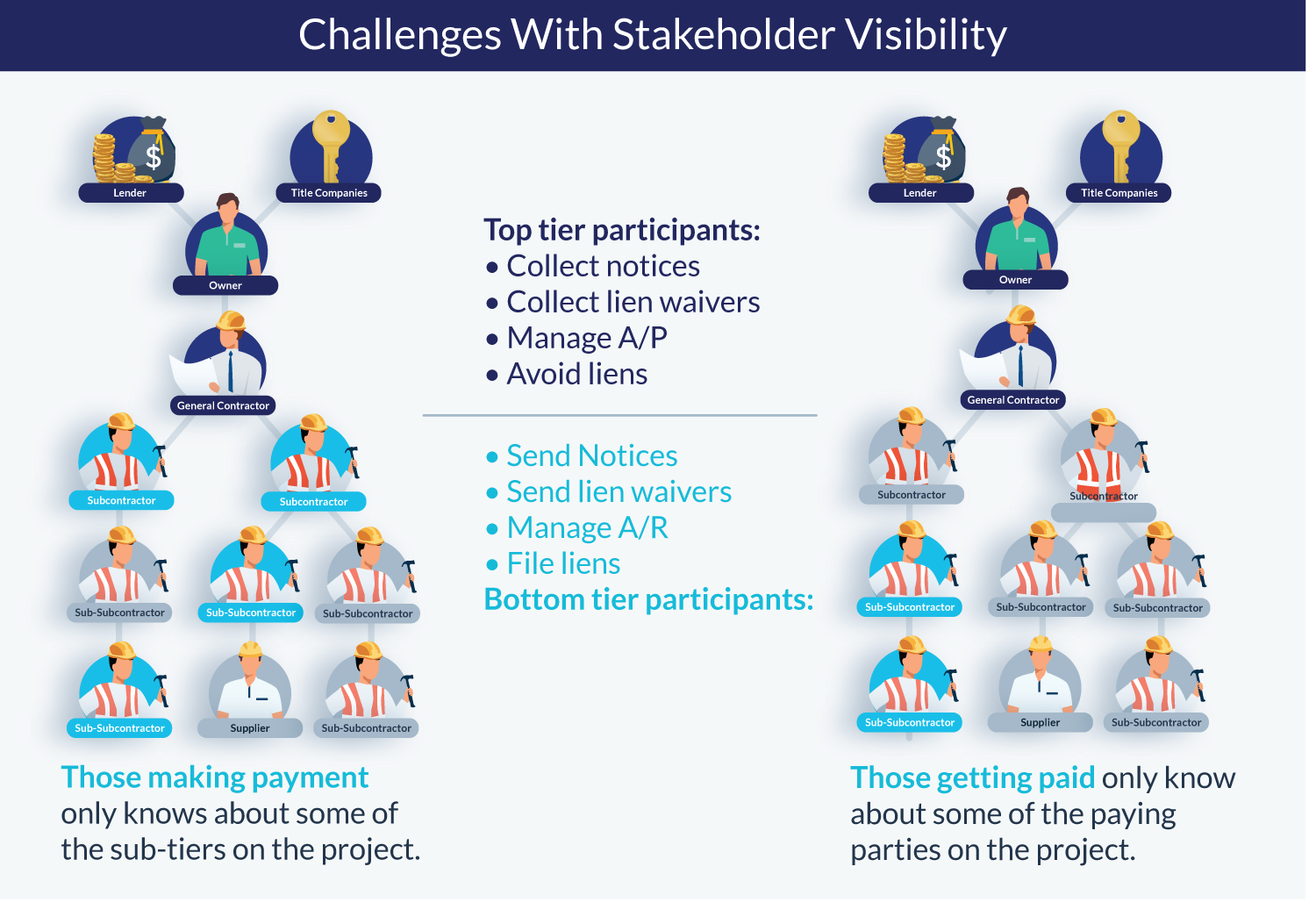
Those making payment — the lenders, owners, and general contractors — are not going to contract their way around sub-tier protections. And those getting paid — the subcontractors and suppliers — are not going to legislatively force anything. And those building software products are not ever going to catch up with all the noise.

The industry needs a dramatic shift in approach.

Out there on the Internet, nestled away on a small legal blog published by Taft Law in Cincinnati, Ohio, there’s a pithy “law bulletin” that you’d likely never find or read, written by one Joseph Cleves, Jr., titled The Paradigm Shift on Risk in Construction. “Joe” is a practicing construction lawyer. He calls out the industry, and it’s worth quoting him almost entirely:

Many owners still rely on heavy-handed contracts to provide them with risk certainty. The goal is to reduce their risk by shifting it to designers and contractors.

While this approach has a certain logical appeal, it has the paradoxical result of increasing risk instead of eliminating it. A review of case law shows that careful drafting of contracts does not provide the imagined protection…The deeply fragmented landscape of legal precedent has resulted in an environment where the outcome of disputes and impact on contract terms are unforeseeable. Rather than placing a premium on careful contract drafting, this approach renders contract drafting useless in the circumstances for which it was intended.

The search for stability calls for a dramatic change in approach — a paradigm shift. Among the possible solutions on the horizon, only an approach that eschews claims-making and litigation seems to offer the potential for success…

The construction payment process is a shared process between multiple different industries. These industries are full of good people who want the best for their business, their families, and themselves.

“Every nation has the government it deserves,” declared the French writer and diplomat Joseph de Maistre in 1811.

The problem is in the hands of the people who are suffering from the problem. Not the regulators.

Take a pause and think about the types of job participants who cause problems. You know these people exist. Just imagine how terrific it would be if you never had to do business with any of them? If you only did business with companies who had empathy for everyone on the job, who were transparent and took head-on the messy and sensitive payment processes, and who empowered everyone to work together on a foundation of clarity? Wouldn’t that be nice?

What if that was the pre-qualifier for who you did business with?

What if your prequalification process simply looked for partners who had the same world view as you, and who operated under the same reasonable methodology?

Well, it’s in your hands, isn’t it?

The status quo is not working for anyone, and it’s not going away by itself.

It’s time to shift the paradigm, from a culture of leverage and protection first — a futile attempt to achieve “risk zero”, to a culture of collaboration first.
Why Does it Take So Long to Get Paid in Construction? And What Can I Do About It?

The fact that the construction industry has a payment problem comes as no surprise to industry participants. In fact, it takes longer to get paid in the construction business than it does in just about any other industry. First of all, a company has to complete time- and information-intensive payment applications just to get in line for payment. And while construction companies are waiting for those payments, they have to somehow find the cash needed to float all of the upfront costs required to get a project off the ground. And when those payments finally do come in, chances are it’s going to be at razor-thin margins.

Further, the complicated payment structure, high failure rates throughout the payment chain, hidden parties, the risk of liens or double payment, and confusing or complex contractual clauses make efficient payment nearly impossible – whether you’re the party that’s paying the invoices, the party waiting to get paid (or both).

How long does it take for construction businesses to get paid?

In 2018, it took contractors an average of 83 days to get paid, according to an annual PWC report. That number increased from 74 days in 2017.

The complex nature of construction payment and the associated rules and regulations have made it difficult to streamline payment. Subs, sub-subs, and some suppliers or equipment rental companies have had a remarkably challenging time getting paid, or at the very least, getting paid on time. And property owners, GCs, and developers have had significant difficulties in properly controlling payments and controlling their risk of double payment.

One overarching reason is construction’s heavy dependence on credit for work and materials. Many construction companies occupy both sides of the credit fence. That is, they both extend credit to other parties on the project, and provide labor and/or materials on credit themselves. Another hallmark of construction payments is that participants are working on thin margins with significant upfront cash needs. The bottom line is that it’s not unusual for construction companies to wait to make payment until payment is received from the party above.

In fact, some of the legal protections to ensure prompt payment are based on a time period that only begins after the party required to make payment gets paid themselves. When this is coupled with contractual provisions like “pay-when-paid” or even (in some circumstances) “pay-if-paid” clauses – it’s easy to see how payment can end up sluggish. And, the lack of visibility on many projects makes it easy to see how higher-tier parties feel they must be extra-cautious to avoid hidden liens or paying twice.

Everybody can agree on the fact that there are problems with construction payment – but where the agreement ends is what the particular problems actually are.

A Top Down Problem: Money Flow

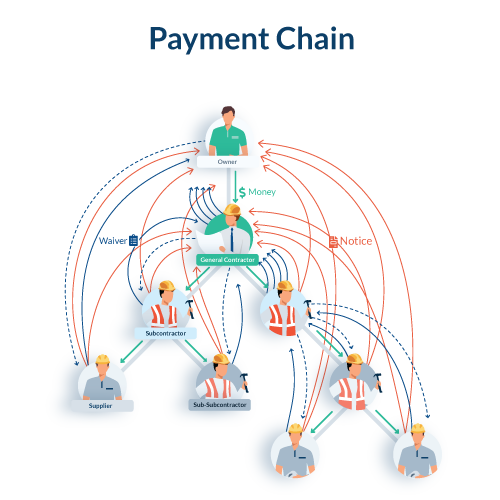
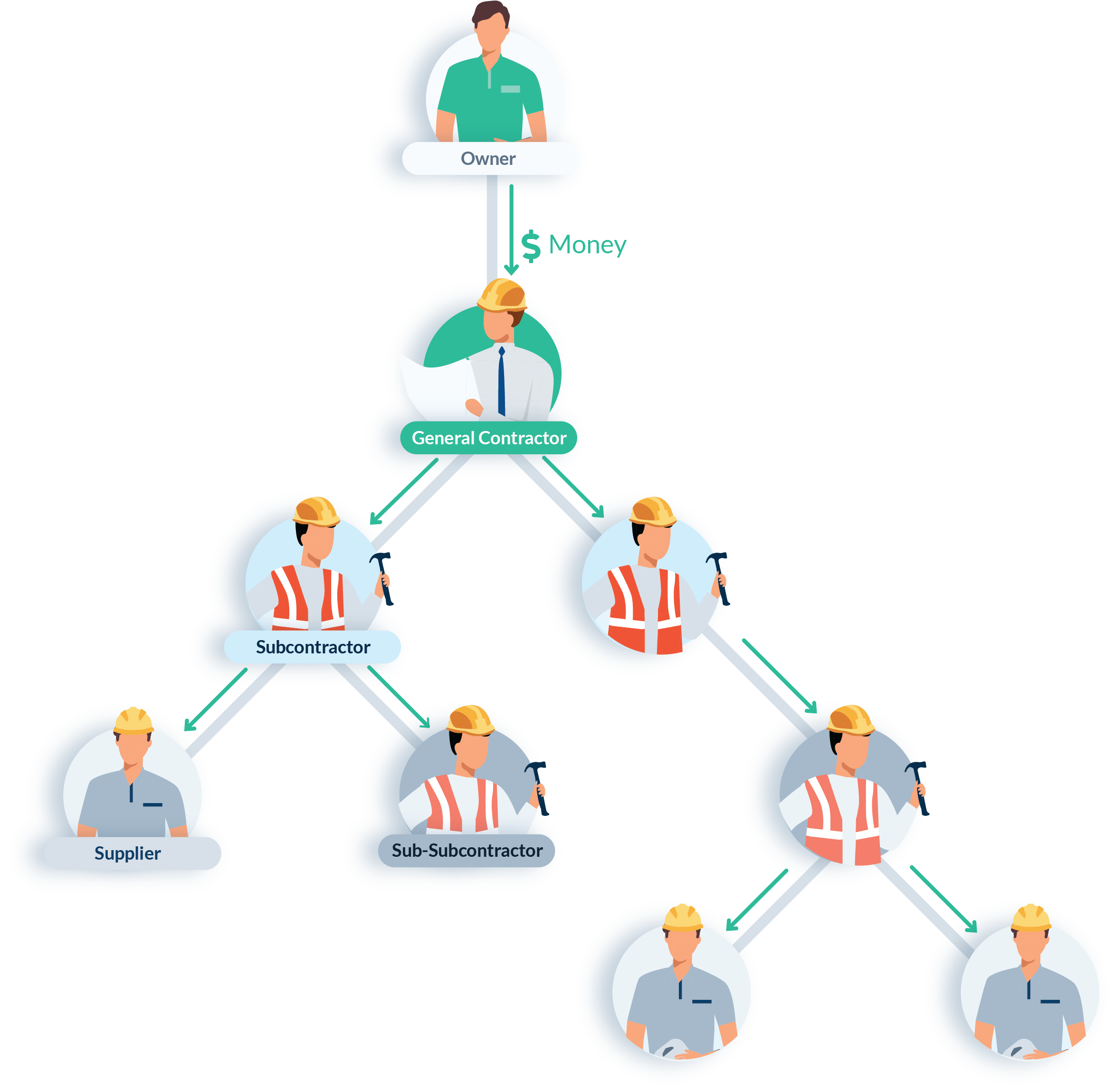
Pay chain in construction money

Since general contractors are located near the top of the payment chain, they deal with financial risks that are both similar to and distinct from the subcontractors, sub-subs, and other parties below them.

GCs worry about getting paid just like everybody else. But they are also required to manage payment down the chain, and protect the property/project/owner against the risk of liens and double payment.

The lack of visibility throughout the total project can make this especially difficult. A particular sub-sub’s material supplier may be unknown to the GC — and it’s nearly impossible (and unfair) for GC’s to be tasked with managing payment to make sure that party gets paid. If a participant is unknown to the GC, how can the GC appropriately manage payments?

Read more: How your position on the payment chain affects your rights

The offshoot of this visibility problem is that GCs and property owners have a reasonable worry regarding the risk of double-payment or stoppages in work triggered by liens, whether or not the usage of lien rights is warranted.

While lower-tier parties have a significant and appropriate objective to get paid – the top-of-chain parties have an equal interest in making sure they are not required to pay more than once for the same work, and protect against knee-jerk lien filings. Accordingly, payment slows down as the top-of-chain parties look to protect themselves, and insulate the project from the risk of liens.

This protection is gained both through contractual risk-shifting provisions (the fairness of which vary and can be disputed) and through the collection of lien waivers in consideration of payment. As many of the contractual risk-shifting provisions, (no-lien clauses, pay-if-paid or pay-when-paid provisions, etc.) have been struck down or weakened when examined by courts, the use of lien waivers as protection and as a mandatory prerequisite to payment has grown. This necessity to collect lien waivers from (virtually) every project participant prior to making each progress payment contributes to the slow payment problem.

A Bottom Up Problem: Document Flow

Payment is slow: There really isn’t much debate about this fact. GCs will agree that payment is not made quickly, but will argue that it is necessary to make sure that “all the boxes are checked” to keep the project going.

Subs will note that even after completing an application for payment with a lot of required information, they still wait a long time for all the waivers to be collected or for the GC to receive a disbursement from the property owner or lender is frustrating.

And the frustration is further compounded when they need to pay their own suppliers on delivery, prior to getting paid themselves.

How to fix construction’s payment problem

As unbelievable as it sounds, construction payment can be fair, streamlined, and efficient. While the fundamental underlying structure of the credit-based process is not likely to go anywhere and will continue to cause occasional problems, many of the underlying issues making construction payment slow can be addressed and resolved.

Read more: The ultimate guide to getting paid in construction

To do so, two of the main problems that are most responsible for the delays must be addressed: Visibility and risk of double payments or liens.

Stakeholder visibility is a problem in construction

1. Improve sub & supplier visibility

If a fix to the construction payment problem must be based on fairness and transparency, visibility is fundamental. In order for the GC to properly manage payment and protect against the risk of double payment, (both of which are requirements to faster payments) every party on the project should be known. Fortunately, this can be easily accomplished in a way that provides benefits to everybody.

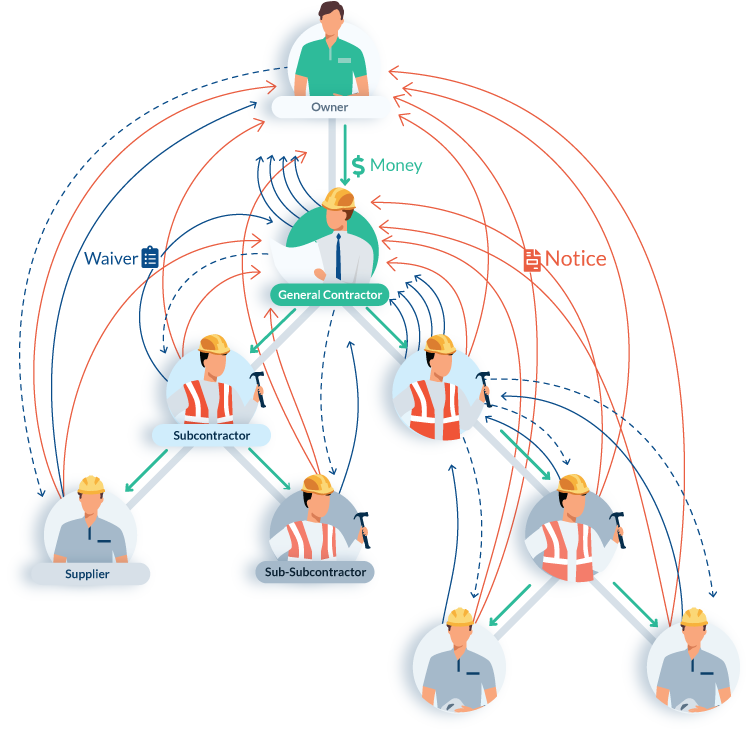
While many GCs understand that receiving preliminary notices from lower-tiered parties is a general aspect of doing business, they should be ecstatic to receive these notices. Preliminary notices are a built-in tracking and management system. If the GC uses construction software, the notice information can be input and the identity, payment status, security status, and lien-waiver status of all parties can be tracked.

The ability to track all project participants allows the upper-tiered parties to manage exposure by providing a made-to-order checklist of parties from whom lien waivers may be required.

2. Send lien waivers all the time, every time

Lien Waivers and the payment chain

The second step of speeding up construction payment revolves around lien waivers. Lien waivers are routinely requested in consideration for payment, no matter what rung the paying party inhabits.

Know a good way to get things to happen more quickly when you know what’s going to be required? Give that thing up front without being asked. Providing conditional lien waivers with every pay app or every invoice makes good business sense for lower tiered parties – and can knock a step off the payment process (and, accordingly, speed it up).

If a lien waiver is going to be needed – and it will be – provide the lien waiver automatically. Using a conditional lien waiver protects the waiver provider and the paying party: the waiver doesn’t waive lien rights to the extent the party is not paid; but completely waives rights to the extent the payment is made.

Streamlined exchange = faster payment.

It’s undeniable that the construction payment process is complex, convoluted, and messy. However, it can be made fair, manageable, and quicker by understanding the problems and attacking them in a fair and focused way. By focusing on solutions that provide benefits to both the bottom and the top of the payment chain, payment can be sped up in a way that leaves each party satisfied.


Late Payments in the Construction Industry – Who’s to Blame?

We read with great interest an article published in May 2017, in ENR (Engineering News-Record) by Thomas C. Schleifer, PhD., a construction industry expert. Dr. Schleifer has 45 years of experience doing every conceivable job in the field and in the office, from laborer to foreman to executive. He has also owned his own construction company and has spent a significant portion of his career as a consultant specializing in turnarounds of distressed and failing construction firms.

Dr. Schleifer’s provocative article began with the attention-grabbing headline: Is Late Payment Your Own Fault?”

Mechanics Lien Form Download

Get free mechanics lien form

We're the mechanics lien experts. We offer forms made by attorneys and trusted by thousands.

Download Free
Continue reading “Late Payments in the Construction Industry – Who’s to Blame?”


Retainage can be a Huge Burden for Subcontractors

Even as retainage continues to be widely accepted and commonly practiced in the construction industry, the majority of subcontractors interviewed for a 2004 report published by the American Subcontractors Association hold the view that “[prime] contractor abuse of their retainage” is a widespread problem.

Some of the data uncovered by the report are troubling:

  • Subcontractors say that they end up receiving less than the full amount of retainage withheld on more than 10% of their projects.
  • On normal projects with no major disputes, subs had to wait anywhere from 30 to 900 days after completion to collect the final retainage due to them, with an average wait time was 167 days.
  • Asked about the single longest retainage wait they had encountered during their careers, subs reported that the worst cases ranged from a low of 60 days all the way way up to 2500 days (that’s almost 7 years!), with an average wait time of 567 days for each sub’s worst case scenario story.

Continue reading “Retainage can be a Huge Burden for Subcontractors”


CFM Review: Chicago Cubs Renovation Hinges on One Word

Construction Financial Managers Weekly ReviewEvery Friday, we select a few articles from the week that we think are worth your time as a construction financial manager (CFM). We look for compelling articles not only about financial topics, but about business, technology, and life, that challenges you to think about your role as a CFM in different ways. 

Welcome back! I hope you enjoyed your Fourth of July.

District Court (and one word) Gives Chicago Cubs a Win

district court gives cubs a winIt’s been 106 years since the Chicago Cubs won a World Series title — the longest championship drought of any major American sports team. Luckily for the ball club, their fortunes in the courthouse are brighter.


In April, the Northern District of Illinois decided in favor of the Cubs in a suit involving the renovation of Wrigley Field (the second-oldest stadium in the country). The suit rested on one word in a contract the Cubs had with neighboring businesses, from the following provision:

The Cubs shall not erect windscreens or other barriers to obstruct the views of the Rooftops, provided however that temporary items such as banners, flags, and decorations for special occasions, shall not be considered as having been erected to obstruct views of the Rooftops. Any expansion of Wrigley Field approved by governmental authorities shall not be a violation of this Agreement, including this section.

See if you can guess which word: Read here to see the answer

North American Payment Disputes total $29.6 Million in 2014, Average 16.2 Months

payment dispute

Have you ever had a payment dispute? You’re not alone.

The total value of disputes in North America totaled to $29.6 million in 2014, according to a report from ARCADIS. While that number represents a drop from 2013, it is up 181.9% from 2011. The average length of disputes increased to 16.2 months from 2013 to 2014.

For the second year running, the number one reason for disputes was “Errors and/or omissions in the contract document.” As evidenced by the Chicago Cubs’ contract provision above, clarity is key, and loose ends can come back to bite.

Specific contract language is especially important for those with less leverage, at the bottom of the contracting chain. According to the report, “In Europe and the US, many contracts secured after 2008, when business was scarce, are based on rock bottom prices and feature a significant additional transfer of commercial risk to the supply chain. Projects like these often create the conditions for disputes.”

The North American section is only 2 pages, and worth a glance: View the report for the full picture

What to Look for in Equipment Rental Agreements

construction equipment rental contracts

Speaking of contract provisions, equipment rental contracts were the topic of conversation at Construction Executive a couple weeks ago.

Alexander Barthet writes specifically about indemnity and “hold harmless” clauses. Typically, the general contractor indemnifies (releases of liability) the owner of losses or damages, and the subcontractor indemnifies the GC, and so on. (This is not much different than the financial risk-shifting that occurs on construction projects.)

Though it may fly in the face of convention, Barthet reminds readers that indemnity provisions are on the negotiating table while drafting contracts. View Barthet’s article for tips with reading and preparing equipment rental contracts.


Textura: A Friend or Foe To Subcontractors?

Subcontractors appear to have a tenuous relationship with Textura’s Construction Payment Management (CPM) platform.

In 2012, for example, American Subcontractor Association members were “grip[ing]” about the product, which general contractors were forcing them to use and pay for.  The gripes were so prolific they warranted ASA President Walter Bazan Jr. to write a letter to the membership in September 2012, and prompted the association’s “Executive Committee [to meet] with representatives from Textura…in an open and wide-ranging discussion” about the member complaints.

Two months later, this turned into Textura and the ASA announcing a “five-year agreement to educate subcontractors” and sponsorship, whereby the ASA got an on-going opportunity to represent its members’ interests and complaints to Textura, and Textura got a forum to court subcontractors.

The motivations for each of these parties are natural and the relationship continues to allow ASA to voice its members’ concerns.

Since Textura is a fact of business in the industry and used by thousands of subs, who also largely pay for the platform, a relationship makes sense. Nevertheless, as this article will explore, there may be some irreconcilable frictions between Textura’s CPM business model and the interests of subcontractors. These frictions threaten to cloak Textura’s courtship of subcontractors with suspect intentions.

Is Textura too Close to GCs to be a Friend of Subs?

Textura’s sales pipeline is full of the world’s biggest general contractors and property developers.  And Textura’s business model counts on buy-in from these parties, who then mandate that subcontractors use, and pay for, the platform in order to get project payments.

Since subcontractors are the end users, Textura must give them some thought. Nevertheless, the inescapable reality is that owners and general contractors are Textura’s true customers.

How might this impact subcontractors?

Consider the following statement made in an article by one of Textura’s institutional investors, Goudy Park Capital, in response to Citron Research’s criticism of Textura’s stock (see: December 2013 – Wolf of Wall Street and September 2014 – The Fraud at Textura). Citron claimed that Textura is hiding “subcontractor churn” (i.e. the number of subcontractors who stop using the platform after becoming a user). In dismissing the argument, the Textura investor basically brushes off subcontractor (un)-happiness as irrelevant:

Citron doesn’t understand the business model – subcontractor churn number isn’t relevant as long as the GCs keep using Textura for their projects. The key takeaway from this is that Textura doesn’t need to spend sales & marketing dollars on the subcontractors – as long as the GCs agree, everyone is required to use Textura’s products. Subcontractors understand the model as well – when a GC looks at a new project, about 70-75% of the subcontractors have already used Textura before. Since the subcontractor is obliged to use the products, Textura also has significant pricing power as well. If a subcontractor is unhappy, the GC will just go to the next subcontractor down the line. [emphasis ours]

The payment process is an extremely sensitive area for general contractor and subcontractor relations, and it happens to be the area on which Textura’s CPM solution is focused.  ASA President Brian Johnson stresses the significance of the payment process in the opening of his March 2015 President’s letter, stating that “[t]imeliness of payments from general contractors to their subcontractors is of great importance to ASA members.”

The payment process presents key risks to general contractors, and they have a specific perspective about those risks.  And, likewise, subcontractors also have risks, and have their own specific perspective.

ENR’s Richard Korman highlights the friction caused by these divergent positions nicely in his summary of a discussion between GCs and Subcontractors during the publication’s annual Risk Summit.

In “Views Differ From Places on the Payment Flow-Chart,” Korman quotes a general contractor saying that “when trouble with a subcontractor arises…’the first question I ask is, how much money are you holding on that sub.’”

Will the product be built to provide protections for subcontractors…or to appease the risk appetite of general contractors and property owners? The opposite sentiment is echoed by subcontractors, who Korman quotes complaining about payment abuses and the practice of “staying ahead” of subs, saying that “[w]e must lead the industry kicking and screaming…to payment reform.”

Textura’s CPM product is built around the payment process, and while the platform is used, and ultimately paid for, by subcontractors, the Textura business development team is focused on selling it to a different audience: general contractors and property developers.

As stated by Textura’s own investors, the company “doesn’t need to spend sales & marketing dollars on the subcontractors…as long as the GCs agree, everyone is required to use” the products.

Given these facts, does Textura spend, or need to spend, product development dollars on subcontractor wishes?  Will the product be built to provide protections for subcontractors and reform potential avenues for payment abuses?  Or, instead, does it make more sense that Textura’s product is and will be built to appease the risk appetite of general contractors and property owners?

Why would Textura build its product to help subcontractors at all?

As the above-quoted investor mentions, the company has “significant pricing power,” and “if a subcontractor is unhappy, the GC will just go to the next subcontractor down the line.”

Analyzing Textura’s Value Proposition to Subcontractors

While Textura’s relationship with general contractors may ultimately be too close for the comfort of subcontractors, Textura is trying to change this position, and avoid that result. After all, a huge majority of its actual user base is comprised of subcontractors.

This explains why the company has reached out and worked with the American Subcontractor Association to become a platinum sponsor. Similarly, it explains why the ASA is entertaining the relationship, as the CPM platform is a fact of business for many subcontractors and there is value in establishing a dialogue.

Accordingly,  CPM’s promotional literature stresses the existence of a  value proposition for subcontractors.

The two main value propositions stated on the CPM website is that subcontractors who use the product will: (i) get paid faster; and (ii) stand out from the crowd.  The next section of this post will analyze each in turn.

Alleged Value Proposition 1: Getting Paid Faster

Every subcontractor on the planet is interested in getting paid faster.  Subcontractors face huge working capital challenges because of the industry’s traditional payment schedules, and this is intensified by general contractor risk shifting practices like pay when paid clauses, pay if paid clauses, onerous lien waiver agreements, and more.

To determine whether Textura’s CPM platform can truly help subcontractors get paid faster, one must analyze the causes of why subcontractors have a payment speed problem in the first place. Then it can be determined if Textura’s CPM platform offsets those problems.

The subcontractor’s payment woes begin with the construction contract arrangement, which requires the subcontractor to buy the supplies, provide the tools and equipment, pay for labor, and perform work before applying for payment.  Then, after the work is in place and the subcontractor has spent its working capital, the subcontractor can apply for payment and wait the requisite “review and approval” period to get paid.

These components of the construction payment timeframe is responsible for a huge chunk of subcontractor payment delays, and Textura’s CPM doesn’t really do anything to change this timeframe. In fact, even the newly announced “Early Payment Program” appears to miss this upstream cause of problems, as expressed by ASA President Brian Johnson in his March 2015 letter to membership cautioning that Textura’s Early Payment Program “does not improve the approval timeline by the GC of a submitted subcontractor/supplier invoice.”

Subcontractors using CPM must still buy the supplies, provide the tools and equipment, pay for labor, and perform the work before ever applying for payment. And then, the subcontractor must still wait for the requisite “review and approval period.”

However, CPM’s “get paid faster” claim is not completely devoid of merit.  Textura’s CPM platform is designed to streamline the process by enabling subcontractors to electronically make payment applications and exchange required documentation. This functionality addresses a secondary reason why subcontractors have a payment speed problem: the process of getting paid is paper-heavy, clunky, slow, and inefficient.

Textura’s value proposition is stronger in this respect.

When subcontractors, general contractors, and all other related users are proficiently using the platform, the exchange of documentation can happen faster, which ideally means that a few days can be shaved off the payment process.

With that said, however, the technology is a process-efficiency improvement for subcontractors and general contractors, not a game-changer.  While the players may be more efficient, they are still playing by the same rules. It does not change the status quo; subcontractors are still financing the job, they are still shouldering the financial risk, and they still have to do all the work and then wait quite a while before payment comes through the door.

Alleged Value Proposition 2: Standing Out From The Crowd

The second alleged value proposition is really interesting because it has an unfortunate “negative” aspect.

According to the CPM website, subcontractors can “rise above the crowd and demonstrate that they are reliable, dependable…” by being on-board with Textura’s platform. However, does this value proposition instead infer that those who do not accept Textura’s platform won’t be considered?  It calls to mind Goudy Park Capital’s comment that “if a subcontractor is unhappy, the GC will just go on to the next subcontractor down the line.”

Since Textura-GCs will require all of their subcontractors to use the Construction Payment Management platform, it’s intrinsically true that subcontractors who embrace the platform will “stand out from the crowd” against those who do not. They will be allowed to work on the project.

It’s not clear, however, how this translates outside the Textura eco-system, or how this is a value proposition specific to subcontractors.

Does Textura’s Lien Waiver Process Make it Easier for Subcontractors to Sign Unfair Lien Waivers?

Perhaps the function of Textura’s CPM product that provides the most relevant information to decide whether Textura is a friend or foe of subcontractors is the treatment of lien waivers.

Almost assuredly, the CPM’s most important feature is assisting general contractors in the collection of lien waivers from subcontractors. In fact, Textura claimed as much in their 2013 S-1/A filing with the Securities Exchange Commission, which states:  “A key differentiator…[is the] ability to handle the generation and exchange of lien waiver…[which reduces] the risk of claims.” p. 83-84.

To subcontractors, Textura promises that it’s lien waiver exchange solution will “automate an inefficient manual process,” with the side-effect of speeding up the payment process and speeding up payments. To general contractors, the promise is that the lien waiver exchange solution will “reduce financial and legal exposure” and “claims.”

Determining whether Textura, at it’s core, is a friend or foe to subcontractors, therefore, may simply boil down to how Textura handles this sensitive exchange.

There have been a lot of posts here on the Construction Payment Blog about lien waivers, with a strong focus on how lien waivers themselves, and the lien waiver process as a whole, can be unfair. The construction industry is riddled by onerous, complex, insufficient, or over-reaching lien waiver forms that are simply unfair to subcontractors.

When subcontractors are asked to sign a lien waiver they are in a very vulnerable position. Short on working capital, they are asked to sign a document in exchange for cold, hard cash. Unscrupulous property developers, lenders, and general contractors can take advantage of this position and load lien waivers with tons of contract-altering provisions and expansive claim waivers.

Since the Construction Payment Management platform’s “key differentiator” is the lien waiver exchange process, one should question whether Textura insulates subcontractors against these unfair practices, or emboldens parties to attempt them?

Textura’s CPM does not regulate the lien waiver document.  Since, Textura does not supply language, whether legally required or otherwise, Textura allows lien waivers exchanged through the CPM to say whatever the general contractor or owner wants them to say, and the CPM platform will blindly require subcontractors to sign them as a condition to getting paid.

This is perfect for general contractors, property developers, and lenders. It is especially perfect for these parties if they happen to have malicious intent – they can include any language desired in the lien waiver and use Textura’s CPM to force acceptance of the waiver before payment is made.

But what does this mean for subcontractors?

Is the lien waiver exchange process becoming more efficient and automated in a good way, or are the efficiencies and automations favoring the paying parties at the risk of the parties waiting to get paid?

Subcontractors Get Bullied Already.  Is It Getting Easier or Harder?

At the ENR Risk Summit in 2013, subcontractors complained about payment abuses, stating strongly that “we need to lead the industry kicking and screaming to payment reform.”

The truth for subcontractors is that it’s easy for them to get leveraged. They have a tough position in the construction contracting chain, and this is not lost on the American Subcontractor Association.

The ASA’s vision is to be the “united voice dedicated to improving the business environment [for subcontractors] in the construction industry.” In doing that, the ASA advocates against contingent payment clauses, onerous notice and claim provisions, mechanics lien and bond claim restrictions, over-broad lien waivers, and other common actions taken by general contractors, developers, and lenders to shift more risk and more exposure onto subcontractors.

These risk-shifting actions have been taking place for over 200 years.

Textura’s business model has the company selling CPM to general contractors, property developers, and lenders proposing that the product will enable them to reduce legal exposure and financial risk.   For subcontractors and the ASA, however, there is an arguable problem with the CPM business model, in that the tool emboldens general contractors to exert even more leverage and pressure in the payment process, a process “of great importance to ASA members.”

Subcontractors are already “kicking and screaming” for payment reform because of these commonplace payment abuses, and the ASA is spending tons of money and resources to fix regulatory leaks nationwide that put subcontractors in financial risk trick-bags.

Subcontractors need more friends on board – but is Textura a friend that can be on their side, or a wolf in sheep’s clothing?

Everyone Benefits from a Fair Construction Payment Process

There is nothing inherently wrong or unfair about the construction industry’s payment processes. The industry’s landscape just makes it really, really hard to actually pull off. There are problems around every corner:  personality conflicts, weather, unknown site conditions, workmanship disputes, and more.

Precisely because so much can go wrong, industry participants have spent decades trying to insulate themselves from those problems.

The legislatures created mechanics lien laws to ensure subcontractors are paid. General contractors combatted with contingent payment clauses and lien waiver contracts to push the risk of non-payment off their shoulders.  And on and on.

What if the best way to insulate against problems and risk was just a commitment to fairness?

Let’s travel upstream and figure out how companies go from good intentions to maximizing leverage. What explains this? Companies don’t go into new projects intending to out-leverage other participants. They wind up there because they are hyper-paranoid about down-the-chain risks, and engage in a battle to “stay ahead” of the other party on payments. This incrementally builds pressure across the project’s participants, and everyone winds up with the things they were trying to avoid: liens, claims, delays, and disputes.

So let’s travel upstream and figure out how companies go from good intentions to maximizing leverage.  What explains this?

We assert and believe that the explanation is simple. Parties have become so crazed about collecting contract negotiation wins and leverage points that they overlook a simple solution: more transparency and a commitment to a fair process.

The mechanics lien remedy may have a lot of baggage.  After all, everyone is trying to avoid lien claims. This tool, however, was not created to torment lenders, property owners, and general contractors.  To the contrary, it was created to establish a risk baseline:  Those who are commissioning the project must pay for it.

Everyone agrees with this risk baseline, and mechanics lien and bond claim laws are full of protections for all parties in the contracting chain.  Those looking to get paid for work done can use the lien right to make sure they do.  Those needing to pay for work, can use the preliminary notice process to make sure they know who to pay and where their risks are.

The lien and notice process is not the problem, it’s the solution, and embracing this process is the key to fair construction payments.


Construction Payment Terms and Common Industry Phrases

There are plenty of documents, agreements, provisions, and other terms used in the language of construction and construction finance. Some terms have more than one definition, depending on who you ask, and others overlap in meaning. This glossary of Construction Payment Terms will distill this confusing set of phrases into an easy-to-understand nomenclature, broken down by category.

CONSTRUCTION PARTIES

Top-of-Chain, or High-Tier

People and businesses that are closer to the source of money on a given project, and that typically hire other people to do work for them. On large projects, this would include, lenders, property owners, developers, and general contractors. On smaller projects, it might include homeowners and general contractors.

Bottom-of-Chain, or Low-Tier

People and businesses that are hired by others to do the actual work on a project. These parties typically are the first to do work and the last to receive payment. This group usually includes material suppliers and sub-contractors.

Risk-Shifting Mechanism

Any tactic moves financial risk from one party to another, such that if payment issues arise on a project, those bearing the risk will be the ones that are paid last (if at all).

See: Pay-When-Paid Clause, Pay-If-Paid Clause, Lien Waiver

LIEN DOCUMENTS

Required Document

A document that must be filed or sent at a time specified by law in order to preserve your right to file a lien. Some required documents must follow an exact format, whereas others only need contain certain information. One document (e.g. a Preliminary Notice) may “required” in some states but not in others. Documents that are not required are considered voluntary.

Voluntary Document

A document that is not required to preserve the right to lien, but may sent with the intent of encouraging somebody to pay you for money earned. For example, many people send voluntary Notices of Intent to Lien (NOI) as a way to prompt payment from their customers, even though they may file a lien without sending a NOI.

Mechanics Lien

Mechanics liens are the foundation of the entire lien process. This document is a statutory lien on real property that provides security to people/businesses in the construction industry who provide labor and/or materials toward the improvement of real property. Liens are official documents that must be filed with government offices (usually the county), and they do not go away until officially released or canceled.

Liens help those who file them receive payment by tying up the property and holding property owners accountable, among other things. In rare cases, when property owners do not resolve lien disputes informally, liens can be enforced in court and result in foreclosure of the property in order to pay outstanding debts to those who filed the lien.

Also known as: Notice of Claim of Lien, Statement of Lien, Statement of Claim and Privilege, Construction Lien, Affidavit of Lien, Memorandum of Lien

Pre-Lien Notice

Generally speaking, this is a catch-all phrase that includes any notice sent or filed before one files a lien. Preliminary Notices and Notices of Intent to Lien are examples of pre-lien notices.

See: Preliminary Notice, Notice of Intent to Lien

Preliminary Notice

Notice given to project leaders (e.g. general contractors, property owners) at or near the start of work on a project. This notice (1) makes leaders aware of your involvement on the project, (2) protects your right to file a lien later on in cases where preliminary notices are required.

Also known as: Pre-Lien Notice, Notice to Owner, Notice to Owner and Contractor, Notice of Furnishing, Notice of (Lien) Rights, Notice of Contract, 20-Day Notice.

Notice of Intent to Lien (NOI)

NOIs are a warning, sent to project leaders before filing the lien. NOIs are required in a small number of states, in which case it is mandatory to send them first in order to file a lien. When not required, NOIs operate as an industry-specific demand letter that prompts payment by threatening to file a lien. They also give debtors an opportunity to pay before having a lien filed against their property.

Also known as: Notice to Owner, Notice of Non-Payment, Statement of Account, Notice of Unpaid Balance

Lien Waiver

Waives the right to file a lien and go after a specified sum of money. Lien waivers can be conditional or unconditional, and may be for final payment or for a partial/progress payment. Lien waivers are not usually required, but are frequently exchanged when payment is made. In 12 states, when exchanging waivers, you must use specifically designated documents as a template.

Release of Lien

A Release of Lien releases, or cancels, a lien that has already been filed, removing the lien from the property it was filed against.

Also known as: Lien Cancellation, Lien Release


PUBLIC PROJECTS

Bond Claim

A lien for public projects, effectively. Contractors and material suppliers can file a claim against a bond if they have been unable to collect money owed for work they performed on a project with a bond.

Bond claims, like liens, must be recorded with a government office and often require that you have files or sent certain documents before hand. A bond is required on public projects by the Miller Act or Little Miller Act, and is usually obtained by the general contractor as a form of insurance, should there be an issue with funds.

Payment Bond

A bond posted by a contractor that benefits all subcontractors and material suppliers below that contractor. In the event of payment issues, those subcontractors and suppliers can file a bond claim against the payment bond. Payment Bonds are more common than Performance Bonds, which they are often confused with.

Performance Bond

A bond issued by a surety, bank, or oanother guarantor to the benefit of the property owner. The property can make a claim against the performance bond if any contractors do not perform their jobs.

Surety

The party that pools together the money for a bond (and puts forth the bond) for a public project. This could be a surety company, a bank, insurance company, or any other guarantor.

CONTRACTS

Pay-if-Paid Clause

A clause often found in construction contracts that states, Party A will only pay Party B if Party A is paid first. This provision is a tactic that attempts to shift financial risk and place the burden of non-payment on lower-on-the-chain construction parties (e.g. subcontractors and material suppliers).

Courts generally look upon this provision unfavorably and routinely treat it as a Pay-When-Paid clause. In some states Pay-If-Paids are completely forbidden from contracts.

Pay-When-Paid Clause

A clause often found in construction contracts that states, Party A will pay Party B only when Party A is paid. Unlike the Pay-If-Paid clause, courts read this to be a timing mechanism (payment must ultimately be made), and not a risk-shifting mechanism. If the paying party (Party A) does not receive its payment, courts generally require that payment be made (to Party B) within a “reasonable” amount of time.

Joint Check Agreement

An agreement stating that two or more parties will be co-listed as payees on a check when payment is made. For example, a material supplier might require a joint check agreement before going to work for a subcontractor, so that when the general contractor cuts a check, it is made out to both the subcontractor and the supplier.

Change Order

An amendment to a contract that includes changes, or additions, to originally agreed upon work (or materials), and corresponding changes in financial compensation.

To stay familiar with all construction payment terms in the industry, subscribe to our blog or chat with one of our experts today!


Building Utopia: How to Fix Construction’s Payment Mess

The construction industry has a payment problem. While not surprising to construction businesses, the extent of the payment difficulties encountered on projects can be surprising to those from other industries. The razor-thin margins, complicated payment structure, high failure rates, hidden parties, and confusing and unfair contractual clauses all combine to create havoc for parties on both ends of the payment chain.

But, what if this construction payment mess could be solved? What if construction payment could be fair to all parties? What if construction payment could be streamlined, optimized, and managed to reduce risk to all parties?

If all of that could happen, it would be the Construction Payment Utopia – and, believe it or not, it’s not as big of a pipe dream as you think. Current and developing technology can and will ease many of the construction payment pain points, and get within shouting distance of creating the utopia outlined above. How? Follow me down the rabbit hole and explore a world in which construction payment problems are a thing of the past.

The Problems With Construction Payment

In order to intelligently discuss what happens in a perfect construction payment world, the challenges of the current set-up should be examined so we know what can be changed, and what can’t, and how that which cannot be changed can be managed or optimized.

Construction Payment Works on Credit

The construction payment scheme is heavily reliant on credit. Nearly all construction industry participants furnish labor and/or materials on credit to some extent. Rather than requiring payment prior to delivery, most construction companies do the work or deliver the materials and then wait for payment. Because the value of the labor and/or materials furnished can be quite substantial, the need to float this cost can detrimentally affect cash flow and even solvency.

This credit-based approach extends throughout the payment chain; many companies both extend credit, and need a line of credit of their own. In many cases, a company’s own bills cannot be paid until payment is received from parties higher on the contracting chain. Because companies must wait for money from the top of the contracting chain, the further down-the-chain a project participant is, the more opportunities there are for that party to experience hiccups or abuses in the payment process.

And correspondingly, these stresses on lower-tiered parties create difficulties and risk for the top, as well. There are plenty of places on construction projects for money to slip through the cracks, and many reasons why payment can get delayed. Because of the interconnected nature of construction payment, any little inconvenience, delay, or dispute about any component of the work can impact payment for everyone on the project, whether or not that party was directly involved – both up and down the payment chain.

Further, this payment environment can force companies to make difficult choices regarding which invoices to pay on time. If a party is forced to wait for its own payment, that company may not have enough ready cash to float the invoices received from parties below.

The fact that there are problems with the construction payment process in general, both in managing payments and in getting paid, is something on which all construction industry participants can agree. However, the “top-of-chain” parties and “bottom-of-chain” parties have specific, and differing, views about the problems, abuses, and frustrations of construction payment. In fact, distrust or apprehension is a fundamental stumbling block to a clear, fair, and optimized payment process – and these feelings are exacerbated by misunderstandings inherent to the current system.

Lower Tier: The View from Below

Lower-tiered parties on a construction project (parties lower on the payment chain), are dependent upon money passing through the hands of the parties above them prior to payment. When this is coupled with delayed, or nonexistent, payment, the blame immediately goes to the top-of-chain parties. It’s no surprise that these parties routinely worry about payment abuses, risk-shifting, and other unfair payment practices keeping them from getting paid.

It’s inarguable that the higher up on the contracting chain a party can be found, the more leverage that party can exert over the payment process. The closer a party is to the money, the more control that party has. And similarly, the fewer steps the money has to pass through before a party gets paid, the fewer chances there are for the money to get stuck.

Since 1) the top-of-the chain parties are able to exert the leverage of payment against the lower-tiered parties, and 2) nobody wants to bear financial risk when it can be avoided, the top of the contracting chain has used the leverage provided by their position to create risk-shifting mechanisms to push the financial risk onto the lower-tiered parties.

Accordingly, this results in resentment and distrust from the lower-tiered parties. In many situations, lower-tiered parties believe that the higher tiered parties have “rigged the game” such that a project’s financial risk is pushed completely down-the-chain.

No-lien clauses, pay-when-paid/pay-if-paid clauses, ultra-strict noticing provisions, over-broad lien waivers, and more have been used to limit financial risk, with varying success. These practices are viewed with disfavor by lower-tiered parties, and oftentimes, their use plays into the narrative that the problems in construction payment come from above. The “GC-as-Bully-dangling-payment-over-the-heads-of-their-subs” view has some relevance, especially to lower-tiered parties struggling to get paid fairly, and on time.

There are also significant difficulties with the process when viewed from the top, however.

Top-of-Chain: The View from Above

The top-of-chain parties are not without their own financial risks and difficulties. Chief among these difficulties is the problem of visibility, and the associated financial risk of liens (and lien abuses) from unknown parties. After all, a GC can’t make sure a supplier is paid if the GC has no idea who that particular supplier is, or that he or she was even on the project.

Far from the payment abuse this lack of payment may be viewed as by the unpaid party, it may be as simple as the fact that the party with the money doesn’t know the unpaid party hasn’t been paid. Because construction projects routinely have numerous parties unknown to the parties with control of the money, the top-of-chain parties are worried about the risk of double-payment or stoppages in work caused by lower-tiered parties’ usage of lien or bond claim rights, whether or not warranted.

Use of the security rights afforded to lower-tiered parties flips the financial risk, but this ability to flip the risk and throw a wrench in the works of a project may not be dependent on the fault of the higher-tiered party (or even pursuant to an actual lien right).

Along with the necessity of managing lien exposure (and protecting against unwarranted lien exposure), the top-of-chain parties also placed in a position of managing parties they generally view to be less financially sophisticated. When viewed in this manner, the liberal usage of lien waivers for payments made down the chain is less predatory (when used appropriately) and more good business sense. While lower-tiered parties have a significant and appropriate objective to get paid – the top-of-chain parties have an equal interest in making sure they are not required to pay more than once for the same work.

Despite these misaligned interests, the distinct possibility of distrust, and unequal bargaining power, construction payment remains, at least to some extent, on relationships. If that is true there must be some common ground, and the potential to optimize the process to the benefit of each side of the payment chain.

Creating a New Construction Payment Utopia

So, how can this problem be fixed? How can construction payment be made fair? It’s impossible to remove risk from the picture completely, and it’s likely impossible to create a completely even distribution of risk throughout project tiers.

It is possible to create a fair system, and a system in which each party knows the exact nature and extent of the risk, and is not forced to accept more than their share.

The construction payment utopia must, in a fundamental sense, be transparent and based on maintaining and growing relationships through fairness.

In order to eliminate the vast majority of payment problems in the construction industry, there has to be buy-in from all tiers of the payment chain – something that so far has remained elusive. Despite the elusiveness of full-chain buy-in, systems and processes already exist that can move the industry in this direction. While a “perfect” payment system is likely a pipe-dream, “near-perfect” payment can be accomplished. And, as compared to the current view of the construction payment system, a “near-perfect” system would be a utopian vision.

Step 1: Send Notices to Increase Visibility & Security

If a fix to the construction payment problem must be based on fairness and transparency, visibility (both of participants, and of those participants’ rights) is key. In a perfect world, every party on a construction project would be known to the GC (or party in charge of the money), along with the parties’ payment and security status. Fortunately, this can be accomplished in a manner that benefits both sides of the payment chain.

Visibility can be promoted by lower-tiered parties sending notices to the higher-tiered parties. Sending notices both protects the lower-tiered parties security rights, and provides upper-tiered parties with the ability to know and track the project’s participants and those participants’ security status. The ability to track all project participants allows the upper-tiered parties to manage exposure by providing a made-to-order checklist of parties from whom lien waivers may be needed upon payment to a sub, and exert control over the payment process. This visibility also benefits the lower-tiered parties by allowing the GC to view the parties that need to receive payment.

Read more: The Ultimate Guide to Preliminary Notice

This first step provides the foundation for a better construction payment process. The top knows the identity of all project participants, and all project participants are protected by the security built into the law for that purpose. Everybody retains some control, and the process has begun to become more fair.

Step 2: Use Waivers to Create Transparency and Optimization

The second step in creating the construction payment utopia requires an adoption of technology, and a shift in understanding. The potential lack of payment is only one problem in the context of construction payment as a whole; slow payment is equally troublesome. Due to misunderstandings, lien waivers reside at the center of the slow-payment roadblock, and mismanagement of these documents can be enormously detrimental to companies on both sides of the payment chain. Optimizing the lien waiver process can fundamentally change the speed of payments, provide protection to every party, and promote transparency and fairness in the construction payment process.

The needs of the lower-tiered parties (getting paid quickly), and the needs of the upper-tiered parties (keeping the project free of lien claims and avoiding double payment) intersect at the lien waiver document. Despite this, however, lien waivers are misunderstood, and the lien waiver exchange process is flawed and sub-optimal.

Given the high stakes, and the legal free-for-all regarding lien waivers, it’s no surprise that problems arise. Using incorrect/not legally sufficient forms, waiving more than contemplated, and signing an over-reaching waiver for the promise of payment can all seriously impact the payment process. Many of these issues, however, can be eliminated by proper understanding and the use of technology.

When fair and correct lien waivers are used in an intelligent manner, all parties benefit. Lower-tier parties gain faster payment and the knowledge that they are not waiving anything other than that which they intend to waive, and upper-tier parties gain legally sufficient waivers from every party immediately upon payment to protect against potential lien claims and double payment. It’s a win-win.

Construction Payment Utopia Needs Better Technology

In order for this result to be reached, however, parties must adopt technology able to create this result. Conditional waivers (conditioned upon the actual payment) should be sent by every party along with every pay-app or invoice as a matter of course.

This seems a stretch, but since the waiver would be conditional, nothing is actually waived unless payment occurs. When that payment does occur, an unconditional lien waiver should be immediately generated and sent. The result: faster payment, less lien exposure.

By using the “conditional waiver” instrument, parties can avoid the hassle and wasted time of using an escrow-type solution. This solution promotes fairness, transparency, and relationships in the payment process, as opposed to the mistrust upon which the escrow solution is founded. When each party understands that it is not necessary to hold a (conditional) waiver back until payment is actually made, and that an (unconditional) waiver is not something that must be forcefully demanded and obtained prior to payment the system just works better.

While true construction payment utopia is a challenging prospect, new technology, and a slight shift in understanding can create a fair, transparent, and streamlined payment system that best protects everybody’s interests. I think that’s a win.


Pay-When-Paid vs Pay-If-Paid: Contingent Payment Clauses Explained

Have you ever come across the words “Pay When Paid” or “Pay If Paid” in your construction contracts? Pay-when-paid and pay-if-paid provisions are ultimately about determining who will bear the financial risk of a construction project. In other words, if the property owner doesn’t pay, who’s left holding the bag?

Why Pay-When-Paid and Pay-If-Paid Clauses Exist

Pay-when-paid and pay-if-paid clauses are both often found in construction contracts. They’re also known as contingent payment clauses — stating that a payment is contingent on another event (like payment from the owner to the GC). But why do contracts use them?

Well, imagine that you’re a general contractor on a huge new housing development. In order for you to complete the job, you have to hire a variety of subcontracts, such as plumbers, carpenters, painters, carpet installers, and framers.

All of those subcontractors, obviously, expect you to pay them. But where is all that money going to come from? In all likelihood, you’re first going to need to get the money from the developer and/or property owner. Without it, you’ll be unable to pay your subcontractors.

This puts a GC in a difficult position. If you don’t pay the subcontractors, you’ll likely be liable for a breach of contract. Go ahead and pay the subcontractors and you may be paying with money you don’t have (and may never get).

What’s an innocent general contractor to do? Somewhere along the way, one general contractor’s attorney created a work-around: a “pay when paid” or “pay if paid” clause. Both clauses have the same goal: No subcontractor gets paid until the property owners pays the general contractor first.

How Are Pay-When-Paid and Pay-If-Paid Clauses Different?

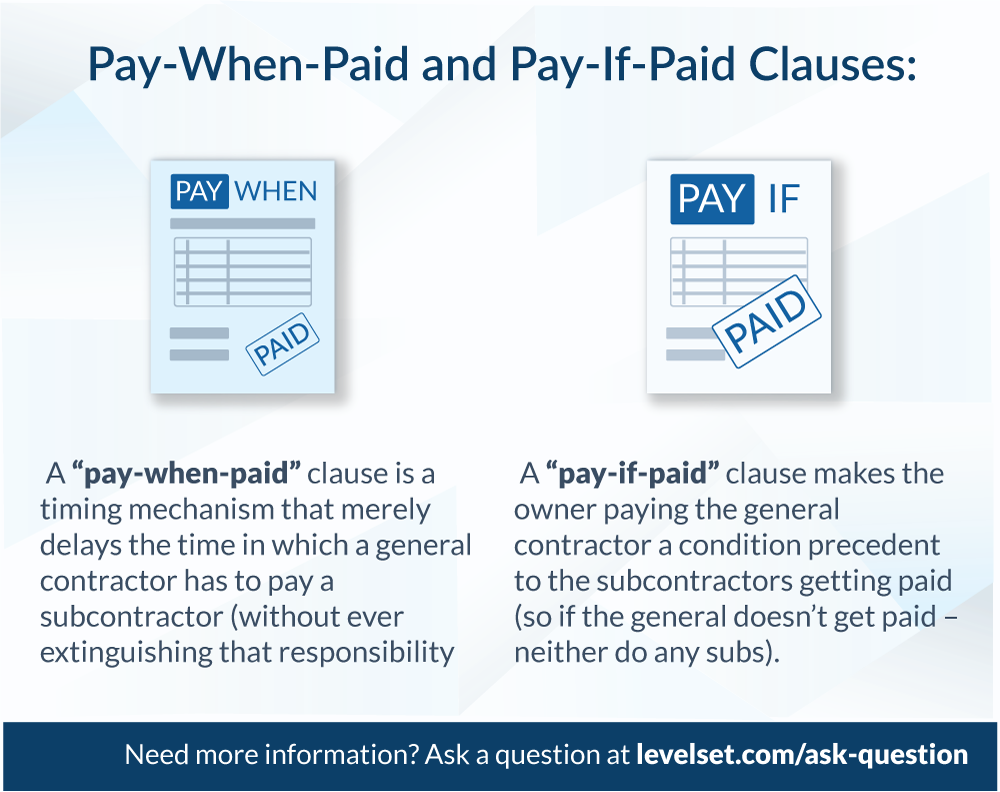
The primary difference between these clauses is that a “pay when paid” clause is a timing mechanism that merely delays the time in which a general contractor has to pay a subcontractor. It doesn’t extinguish that responsibility.

Each state’s interpretation of pay-when-paid and pay-if-paid clauses are different. However, we can make a few generalizations that highlight the primary difference between a pay when paid clause and a pay if paid clause. (Yes, changing one little word – “when” vs “if” – can make a world of difference for both general contractors and subcontractors.)

The difference between pay-when-paid and pay-if-paid clauses

A “pay if paid” clause makes the owner paying the general contractor a condition precedent to the subcontractors getting paid (so if the general doesn’t get paid, neither do any subs).

Explained another way, it’s all about who ultimately bears the risk of owner nonpayment. In contracts with “pay when paid” clauses, the general contractor bears the risk that the owner will never pay them. In essence, even if the owner never pays the general, the general will have a little more time but will eventually have to find a way to pay the subcontractors or be liable for damages in a breach of contract lawsuit.

Pay if paid clauses work the exact opposite way, shifting financial risk from the owner to parties beneath them. In these cases, the subcontractor bears the risk of owner nonpayment.  If the owner never pays the general contractor, then the general has no obligation ever to pay the subcontractors.

Pay When Paid: Timing the payment

Generally speaking, a “pay when paid” clause is a timing mechanism for payment. In other words, it says that the contractor will pay the subcontractor within a certain amount of days after receiving payment from the owner.

That is, the language that a contractor will pay his sub when he receives payment from the property owner is not interpreted to string that time out indefinitely. If the contractor is not paid by the owner, this payment clause does not absolve the contractor from his obligation to pay his subs.

This almost seems counter-intuitive when reading the plain language. If I personally make a promise to give somebody money when I get money from somebody else, I would expect that, until I receive that money, I would not be obligated to pay the person I promised to pay. Courts have rejected this approach.

While pay-when-paid clauses can be detrimental to subcontractors and material suppliers, they are not the be-all-end-all. They only decide when you will be paid, not if you will be paid.

As added protection, most courts hold that, even when a party agrees to certain timing, payment is due down the payment chain within a “reasonable amount of time.” In other words, GCs can’t withhold payment forever, even if they have not been paid themselves.

Pay If Paid: Shifting risk to subcontractor

If GCs were finding themselves in debt, then it seems the pay when paid clause didn’t entirely achieve its objective. Enter the Pay-If-Paid clause.

The sole objective of this contingent payment clause is to shift financial risk down the chain. A pay-if-paid provision states that a general contractor does not have to pay her subcontractor unless she is paid by the property owner.

The bad news for subcontractors and suppliers: Under these circumstances, you could be left unpaid for a job well done.

States that prohibit pay if paid clauses

The good news: most state governments have your back. In the states listed below, pay-if-paid provisions have been outlawed, meaning a court will not enforce them.

  • California
  • Kansas
  • Illinois
  • Indiana
  • Nevada
  • Montana
  • North Carolina
  • New York
  • South Carolina
  • Utah
  • Wisconsin

In most other states, in order for a pay-if-paid clause to be upheld, courts require clear and specific language—the phrase “pay if paid” is not enough.

Here’s an example of sufficient language: “The parties herein explicitly agree that this provision is meant to shift the risk of non-payment.”

Check out our 50-state guide to Pay If Paid clauses to see each state’s policy.

How contingent payment clauses affect mechanics lien rights

Ultimately, neither payment clause affects a contractor’s right to file a mechanics lien. Even in some states where pay-if-paid clauses are accepted in court, they may not be enforceable in cases where a mechanics lien has been filed.

Under these circumstances, a pay-if-paid clause may be enforceable as a defense against a breach of contract lawsuit (or other similar claims), but would not stop recovery of payment by enforcement of a mechanics lien.

It’s important to track your mechanics lien deadlines closely, to ensure that you’re able to file a claim when payment is delayed. If the GC hasn’t received payment from the owner yet, and your lien filing deadline is approaching, you have the right to file a lien claim to lock down your payment.