

Texas lien laws are famous for being a flat-out, expensive mess. The sheer volume of hard deadlines and multi-notice schedules is enough to make any contractor want to walk off the job. But don’t panic. Just because the Lone Star State loves its bureaucracy doesn’t mean you should leave your hard-earned cash on the table.
If you are currently sitting out of the money on a Texas construction project, a properly filed mechanics lien is the most powerful leverage you have to force a slow-paying client to face the music. But “properly filed” is the ultimate catch. Texas is completely unforgiving when it comes to notices, affidavit contents, homestead rules, and retainage deadlines. Miss a single date by 24 hours? Back to square one. You are legally out of the money. This guide breaks down everything you need to know about the Texas mechanics lien process so you can secure your rights and stand your ground.
Before You File: 5 Questions to Ask Yourself
Before you even think about drafting an affidavit, you need to answer five critical questions to ensure you actually have the right to file.
1. Are You Actually Eligible?
Texas mechanics lien rights under Tex. Prop. Code § 53.021 provides robust protection, but they don’t cover absolutely everyone.
- Protected: General contractors, subcontractors, material suppliers, custom fabricators, and design professionals (architects, engineers, surveyors).
- Not Protected: If you are too far down the bottom of the totem pole or providing non-structural services, you might be out of luck
2. Did You Send the Required Texas Monthly Notices?
 This is the absolute minefield that trips up most subcontractors and suppliers. If you contracted directly with the property owner, congratulations; you are the “original contractor,” and you get to bypass the brutal monthly notice grinder. But if you were hired by anyone else, you must assume notice rules apply. Under current Texas law, you have to hit these strict windows to preserve your lien rights for unpaid work:
Nonresidential Projects: You must send your formal notice of claim to the owner and original contractor no later than the 15th day of the third month after the month the unpaid labor or materials were furnished.
Residential Projects: The clock ticks even faster. You must send the notice no later than the 15th day of the second month after the unpaid work occurred.
Under Tex. Prop. Code § 53.056, these notices can be delivered in person, by certified mail, or by any traceable private delivery service (like FedEx or UPS) that confirms proof of receipt. If they actually receive it, the delivery method is legally immaterial, but don’t cut corners. Use a trackable method so you can call their bluff if they claim they never got it.
See the Ultimate Guide to Preparing & Sending Your Texas Monthly Notices
3. Is the Property a Certified Texas Homestead?
Texas is incredibly serious about protecting homesteads. If the project involves an owner-occupied residential homestead, do not treat it like a standard commercial gig. To have a valid lien on a Texas homestead, Tex. Prop. Code § 53.254 dictates that you must have a written contract signed before any work begins. If the owner is married, both spouses must sign. Furthermore, that contract must be formally acknowledged and recorded with the county clerk. If you are a subcontractor working on a homestead, your monthly notices must explicitly include the exact statutory homestead warning language layout. If these steps weren’t taken before the first shovel hit the dirt, you have zero lien rights. Period.
Dive deeper: Filing a Lien on a Texas Homestead
4. What About the Retainage Trap?
Retainage has its own set of rules that can easily drag on forever if you aren’t paying attention. If you are a subcontractor trying to secure your rights to withheld retention, you must act fast. You must send a formal notice of retainage to the owner and original contractor no later than 30 days after your contract is completed, terminated, or abandoned (or 30 days after the original prime contract is terminated/abandoned; whichever comes first). To successfully lock down a lien on those reserved funds, you generally must file your lien affidavit no later than 30 days after the overall project is completed, terminated, or abandoned.
5. Are You Within Your Deadline?
Don’t let a slow-paying client pull the trigger on your deadlines by promising “the check is in the mail” until it’s too late. The deadline to record your Affidavit of Lien with the county clerk depends entirely on the project type:
NONRESIDENTIAL PROJECTS
- Original Contractors: 15th day of the 4th month after work is completed/terminated.
- Subcontractors/Subs: 15th day of the 4th month after last providing labor/materials.
RESIDENTIAL PROJECTS
- Original Contractors: 15th day of the 3rd month after work is completed/terminated.
- Subcontractors/Subs: 15th day of the 3rd month after last providing labor/materials.
*Note: If your statutory deadline lands on a Saturday, Sunday, or legal holiday, Texas law generously extends your deadline to the next business day.
If you’ve checked the boxes and you’re within your legal rights, it’s time to build your paperwork armor. Follow these three definitive steps to get your lien filed and served perfectly.
Watch the video: How to file a mechanics lien in Texas
Step 1: Complete the Texas Affidavit of Lien
Do not treat this document like a casual invoice or a scary demand letter. This is a sworn, verified legal document that must be signed in front of a notary. In looking for your lien form, note that a Texas mechanics lien is called an “Affidavit of Lien.” So, this is the form that you’re looking for. Additionally, the document is slightly different for original contractors (those who contract directly with the property owner) and others (i.e., subcontractors and suppliers). You want to choose the right one:
Information You’ll Need For Your Lien Claim
Under Tex. Prop. Code § 53.054, your affidavit must contain: 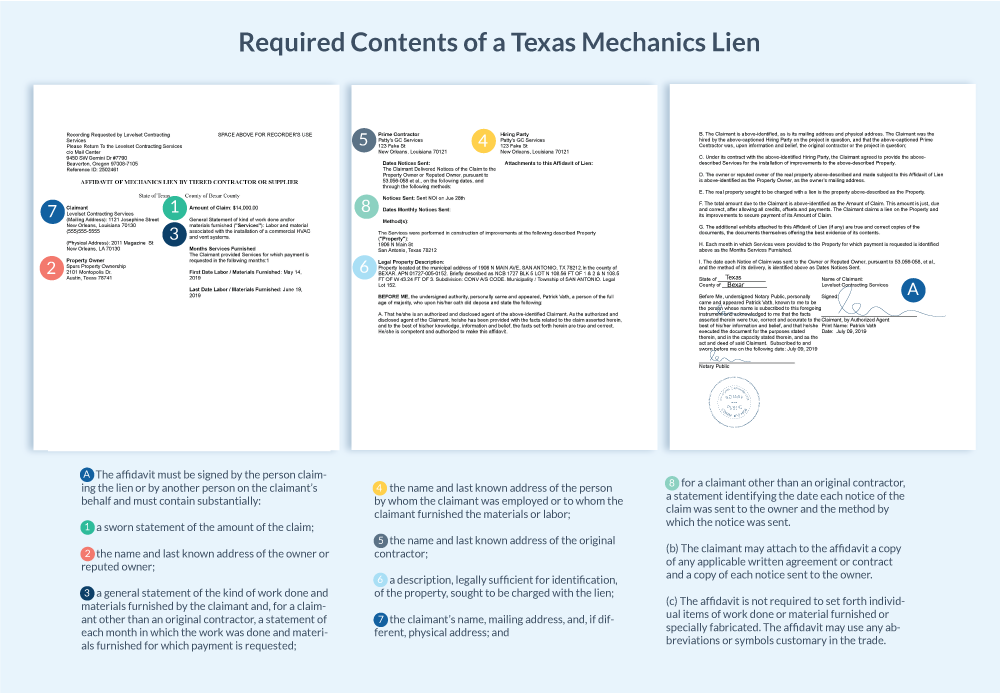
It’s an affidavit: Verify & sign
In filling out your Texas lien form, let’s start with the last step because it’s instructive about all the other steps. The lien form in Texas is an “affidavit” that must be signed and “verified.” Your Texas lien form must have a signature block at the bottom! (You must sign it.) And that the signature block contains language indicating that the information is somehow “verified.”
The statute has this to say about the requirement: “The lien affidavit must be signed by the person claiming the lien or by another person on the claimant’s behalf.”
The Exact Claim Amount
Only include the true unpaid value of the labor or materials provided. Do not pad this number with unliquidated delay damages, legal fees, or contract interest, or you risk facing a fraudulent lien claim. At first glance, this is a straightforward requirement. You want to list the dollar amount that you are claiming to be due. However, this can be extremely tricky to get right because there are some amounts you cannot include in your claim.
You want to make sure to include as much as you’re allowed, but no more. There are significant risks in “exaggerating” the amount due to you in a mechanics lien claim.
What you can include in your lien amount:
- Amounts unpaid to you related to the value of the work and/or materials provided to the job
- Amounts that may be in “dispute” between you and others, so long as they are related to the work/materials put into the job
What you cannot include in your Texas lien:
- Costs of filing the lien
- Interest accrued under the contract
- Liquidated damages or other claims for “damages” caused by contractual breaches, or otherwise
- Attorney fees
While you cannot include these ancillary amounts in your lien claim, you may still be able to collect them through court action if you decide to enforce the lien.
There is a difference between what is owed to you and what you can validly claim in a lien. Make sure you get this right and don’t over-reach, because over-reaching can cost you significantly and can negatively impact your lien rights as a whole.
Any amount unrelated to the value of the labor and/or materials furnished may not be included in the lien claim. However, the court may award legal fees and interest to a successful lien claimant during foreclosure.
Name & address of the owner
Your Texas lien must identify the name and “last known [mailing] address” of the property owner. This is usually quite easy but can have some complicating factors. For example, if the job is commissioned by a tenant instead of the owner, the property is sold or transferred during the job, the owner is misrepresented to you, or the property has multiple owners.
The law appears to offer some flexibility here by requiring you to identify the owner or the reputed owner. However, the term “reputed owner” is not defined, which leaves this open for debate.
Name & address of “original contractor” & person that hired you
In addition to identifying the owner of the property or reputed owner, a Texas lien must also identify two other parties:
- The name & last known address of the person who hired you to the job
- The name and last known address of the original contractor.
The “original contractor” refers to the general contractor — the person whom the property owner hired. If you were hired by the “original contractor,” or you are the original contractor, this section will be really simple for you.
However, if you are a sub-subcontractor or a material supplier, you must identify two different companies here.
Description of your work and/or materials (by month)
You must describe the work and/or materials you provided to the job within your Texas lien. In addition, you must provide a list of months in which you furnished labor or materials for which you are claiming payment.
The bad news here is that you need to list each month in which labor or materials were furnished but unpaid. The good news is that the description of the labor or material can be “general.” It doesn’t need to be itemized and detailed.
Here is how the Texas statute explains the requirement:
[Must provide] a general statement of the kind of work done and materials furnished…[and] a statement of each month in which the work was done and materials furnished for which payment is requested… …[However t]he affidavit is not required to set forth individual items of work done or material furnished or specially fabricated. The affidavit may use any abbreviations or symbols customary in the trade.
Property description
A mechanics lien is a claim against a specific piece of real property. It’s extremely important to identify the property correctly and as completely as possible. This is how the lien gets indexed by the county recorder.
If you don’t get the property description right, your lien is potentially invalid. Furthermore, it could be impotent because no one sees it in the title records!
So, how detailed does the property description need to be?
The Texas statute requires “a description, legally sufficient for identification of the property sought to be charged with the lien.” Unfortunately, what constitutes such a description is not crystal clear.
The Texas Supreme Court has held that a description of the property is sufficient when the description would “enable a party familiar with the locality to identify the premises intended to be described with reasonable certainty, to the exclusion of others.” And other Texas Courts follow this rule generally.
But it’s not easy to apply this rule without a close, legal examination. Even those examinations threaten to be inconsistent. As such, the best practice is to include the property address, lot, and block number. Even better, include a full legal or metes and bounds description of the property (in other words, a “legal property description”).
For some guidance on this, check out our article on Researching the Legal Property Description.
Your name & address
This is the “gimme” field, like getting points for putting your name neatly on the top of your elementary school test. The statute provides that you must provide your “name, mailing address, and, if different, physical address.” Don’t mess this up! Furthermore, if you are filing on behalf of a corporation or LLC, be sure to use the full company name, i.e., “ABC Contractors, LLC.”
You would be surprised at how much can go wrong with this field. Check out the 4 most common mechanics lien mistakes to see how you can easily misidentify yourself in a mechanics lien claim.
List the notices you sent on the job
We discussed the importance of sending Texas monthly notices earlier in this post, and now these notices are coming home to roost. (If you are not the general contractor, you were required to send notices.)
Now, within the mechanics lien document itself, you’re required to confirm that these were sent and identify specifically when you sent them!
The law specifically requires that your lien claim have a “statement identifying the date each notice of the claim was sent to the owner and the method by which the notice was sent.”
Lien claim attachments (exhibits)
You have completed everything that is required. However, you should consider taking another step.
The Texas lien statute says that you “may” include some attachments with your Texas mechanics lien. Specifically, it says that you “may attach to the affidavit a copy of any applicable written agreement or contract and a copy of each notice sent to the owner.”
You should strongly consider including additional exhibits. Attaching these documents to your mechanics lien makes the lien statement stronger, clearer, and protects you against “not having enough” details in your claim document. These problems may arise after your lien is filed, but can even cause your lien to get rejected by the recorder.
Relevant attachments might include any of the following:
- A copy of your written construction contract
- Any invoices or work orders relevant to your work on this project
- Copies of notices you sent to the owner or general contractor
By attaching this type of documentation to the lien claim, you are including pre-emptive proof of the validity of the debt with the lien filing. This should make it more difficult for the owner to dispute your lien claim.
A word of caution, however: while parties may want to include all sorts of documents with their lien claims, excessive pages may rack up the cost to record your lien.
Step 2: Record with the Correct County Clerk

Take your finalized, notarized affidavit straight to the county clerk in the exact Texas county where the property sits. Do not mail it to a generic state recording office. Obviously, this is an extremely important part of this process. Although a Texas constitutional lien is technically “self-perfecting,” recording the lien is required in most situations and is a best practice in all situations. Every county clerk maintains their own specific formatting rules, page margins, and filing fees. Check the clerk’s current real property recording fee schedule before submitting to avoid having your document rejected at the worst possible moment. Here’s a list of all Texas County Clerk’s Offices that file mechanics liens.
Step 3: Serve the Post-Filing Notice Within 5 Days
Filing the lien is only half the battle. If you skip this next step, your lien can be deemed completely invalid. Under current law, you must send a copy of the recorded affidavit to the property owner’s last known address no later than 5 days after the date it is filed with the county clerk. If you are a subcontractor, you must also serve a copy to the original contractor within that same 5-day window. Send this via certified mail with return receipt requested, so you have undeniable proof of the date it was sent. It is a good practice to send a service copy of your lien at the same time as filing, since you are allowed to send an unrecorded copy. This ensures that your claim will get served in time.
If you don’t provide this notice, all of your hard work could be for nothing. Just see how complicated it got for a contractor who filed 47 liens — and forgot to send the notice.
After You File Your Texas Mechanics Lien
Once the lien hits the real property records, it creates immediate, massive pressure. Lenders stop funding, owners stop paying general contractors, and everyone is forced to get on the same page to resolve the dispute. However, a Texas mechanics lien does not live forever.
Enforce/Foreclose Your Lien
A suit to foreclose a Texas mechanics lien generally must be filed no later than the first anniversary of the last day the claimant could have filed the lien affidavit under the current Texas lien statute. The foreclosure deadline may be extended only in a specific way. Before the original foreclosure deadline expires, the claimant and the then-current record owner may enter into a written agreement extending the limitations period.
That agreement must be recorded with the clerk of the same county where the lien was recorded. The extension cannot go beyond the second anniversary of the date the claimant filed the lien affidavit, under the current statutory extension procedure. A notice of intent to foreclose is not the same as a foreclosure lawsuit and does not extend the statutory deadline. It can be an effective collection tool, but it is not a substitute for filing suit on time.
Releasing the Lien
If the lien results in payment, congrats! Now you should be prepared to release it. Texas law allows a mechanics lien to be discharged of record by recording a lien release signed by the claimant, by failure to timely foreclose, by final judgment, by statutory bond procedures, or by certain court-ordered removal procedures. The draft said the lien should be released within 10 days after a written request following payment. The legally safer revised instruction is: once the claim has been satisfied, the claimant should promptly sign and record an appropriate lien release and should verify any deadline triggered by a written demand or project-specific agreement before delaying.